Who Gets The Biggest Bump In Sales Of Licensed Merchandise From A World Series Win?

NEW YORK; October 22, 2015—Macy’s is on top of its game: The flagship Herald Square store rolled out (literally, on racks) a NY Mets display at the 7th Ave./34th Street entrance today. With Majestic, Nike, and Forever Collectibles t-shirts, sweatshirts, jerseys, and tote bags, it was a small array but prominent for sure. “This is all you have?” asked a woman who promptly went through the rack looking for the size she wanted.
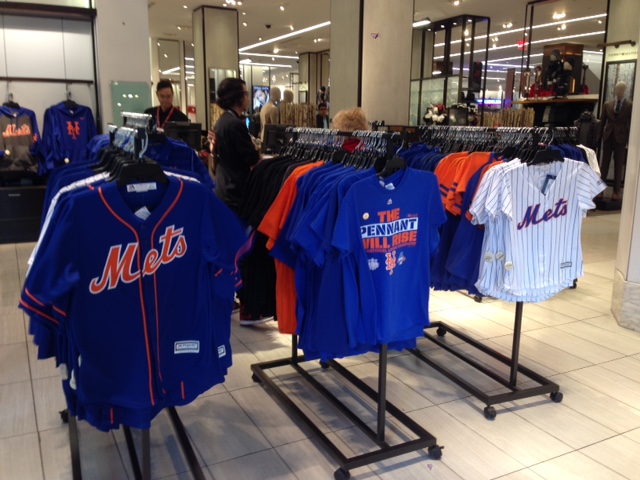
Mets merchandise following its Pennant win at the entrance to the flagship Macy's in Herald Square.

Mets merchandise following its Pennant win at the entrance to the flagship Macy’s in Herald Square.

What does a Mets-Kansas City Royals or Toronto Blue Jays World Series matchup look like from a licensing perspective?

This should be a good year. What licensees don’t want is the same team winning two years in a row, or even two out of three years. As with a series of movies, fans buy their World Series memorabilia in year one; the second film in a series typically doesn’t do as well as the first. That follows for sports teams.

The Mets make it to the series on average every 15 years — 1969, 1986, 2000, 2015. Kansas City competed in the World Series last year, losing to the Giants, and hasn’t won a series since 1985. Toronto won back-to-back in 1992 and 1993 but haven’t been back since. So licensees are good on that count whoever wins. Plus, much of the merchandise during a Series is souvenir goods purchased at the venue and in local stores.

But which team in the 2015 World Series stands to see the biggest bump in merchandise sales? The Mets have a larger home market, though it’s hard to know if there are as many out-of-market fans as there are for the Yankees and the Red Sox. Still, that sizable home market means more customers for merchandise.Macys Mets Vertical 2

Most telling is that there are three Mets on Major League Baseball’s list of 20 most popular jerseys of the 2015 regular season: Matt Harvey (No. 9), David Wright (No. 11), and Jacob deGrom (No. 17). For the post-season, all three will clearly gain traction, with Harvey a good bet for topping the list if the Mets take the series. Maybe even if they don’t. Toronto’s Josh Donaldson is on the list at No. 12, but there are no Royals on the MLB best-seller list at all!

The irony: No. 1 on the regular season list is Kris Bryant of the Chicago Cubs. The Mets, of course, swept the Pennant series…from the Cubs.

Sidenote: The first jersey you see in the Macy’s Locker Room by Lids shop on the fourth floor is a woman’s Derek Jeter “team captain” model from Majestic. There’s very little Mets merchandise up there — it probably got moved to that high-profile location on the main floor, prompting one customer to be sent downstairs to find what he wanted.

Why Walmart Lowering Its Sales Forecast Shouldn’t Startle Anyone

October 15, 2015: If Walmart investors are “startled” by the retailer “slashing its sales forecast for the year,” as The New York Times reports today, they haven’t been paying attention. “Sales will be flat this year, Walmart said at a meeting with investors in New York. The retailer previously said that it expected net sales to grow 1-2 percent for the current fiscal year, through January,” according to The Times.

Bad news? Of course. Startling? It shouldn’t be.

Walmart and others previously reported softer-than-expected back-to-school sales, which are generally a harbinger for the holiday season. But retailers overall tend to be optimists at the beginning of the year, as they talk it up to vendors and investors. The optimism gets toned down when reality sets in beginning in the calendar third quarter.

Sticking with Walmart and looking at the last few years:

October 15, 2014, from CNBC: “[Walmart] Chief Financial Officer Charles Holley, at a meeting with investors and analysts, said he expected Wal-Mart’s sales to rise 2-3 percent from $473.1 billion last year. The company said in February it expected net sales growth to be at the lower end of its 3-5 percent forecast.”

October 14, 2013, from FoxBusiness: “The world’s largest retailer missed sales projections and issued soft guidance for the holiday season.”

And yes, there was good news in 2012, when the company “narrowed” its projections — raising the lower end and maintaining the higher end.

Modifying projections in the face of changing realities is critical to business planning, and Walmart is hardly alone in doing so. They get the lion’s share of coverage because they have the lion’s share of the market and because so many businesses — especially those in licensing — are so dependent on the company’s orders.

But investors, suppliers, and others shouldn’t be “startled” when the numbers head south. There’s a pattern here and an easy lesson: Don’t forget to adjust your beginning-of-year forecasts for reality as you go. Just like Walmart.

Need competitive research to keep your licensing projections on track? To enter new markets? For legal proceedings? Contact ira@iramayer.com.

NFL Kicks Off Super Bowl 50th Women’s Wear Looks

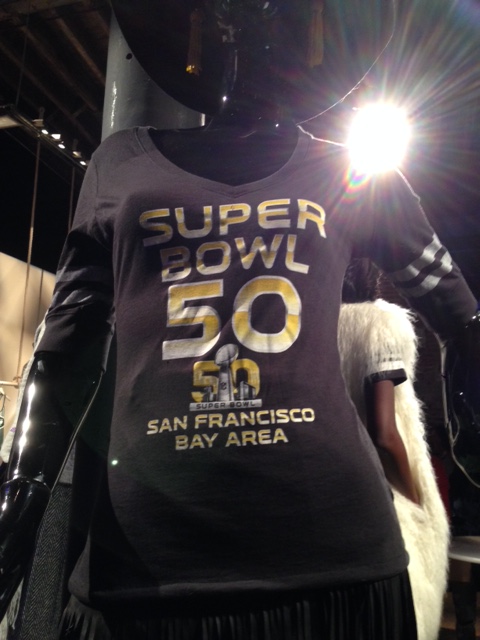
Using a mock fashion show-cum-blogger-reality-show-competition as a format, the NFL introduced the first Super Bowl 50th anniversary women’s wear tonight at a spacious gallery in Manhattan’s Chelsea neighborhood. The event featured three fashion bloggers — Christine Bibbo Herr (NYC Pretty), Liz Black (PS Its Fashion), and Heather Zeller (A Glam Slam) — designing outfits built around Super Bowl 50 shirts and sweaters for the models for athleisure, date night, etc. The Super Bowl 50 merchandise goes on sale October 15th.

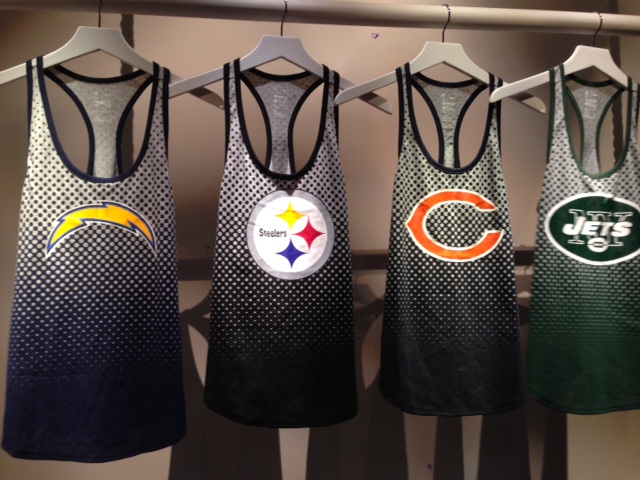
Here are some of the shirts, along with a pair of non-Super Bowl shoes that would complete any look, and a few of the new team shirts for this year.

NFL shirt3 NFL shirt2 NFL shirt1

NFL Shoes NFL shirt5 NFL shirt4

Apparel licensees represented at the media event included Majestic, GIII, ’47 Brand, and Junk Food along with Lulu DK Tattoos. The latter retail for $9.99, are applied with water, and last 4-6 days.

The NFL estimates that 45% of its fans are women, though men’s wear continues to account for a much higher percentage of merchandise sales. I estimate the league did about $3.4 billion at retail worldwide in the 2014-2015 season.

Is Star Wars the (Old) New Frozen?

In the decade following the release of the original Star Wars movie in 1977 the licensing business overall grew more than 10 times, from $4.9 billion in retail sales that year to $54 billion in 1986, according to The Licensing Letter Databook.

Star Wars is credited as the catalyst for much of that growth — certainly in the entertainment sector, but across the rest of the licensing business as well. In recent years, worldwide retail sales of merchandise based on the Star Wars characters and imagery has hovered in the vicinity of $2 billion annually.

So as the rollout of new Star Wars merchandise begins this Friday, with a new movie coming in December, what are the prospects for Star Wars sales now?

A widely reported bullish analysis of Disney’s stock by Macquarie Securities analyst Tim Nollen puts the number at $5 billion in the first year following release of the movie (which is a funny time to start counting, since the merchandise is going on sale more than three months before the movie comes out). Good forecast or is Nollen building unrealistic expectations for investors?

“Star Wars is on a whole other level from anything we’ve ever done,” Dynomighty’s Sydney Pham told me at the NY NOW gift show in New York recently. Dynomighty makes Tyvek wallets, passport holders, and other accessories, and festooned its booth with Star Wars displays.

IMG_1763“We started pre-selling the classic images a month before the [mid-August] show; we’ll have new images from the movie for the spring. But even the classic images are outselling all of the best-sellers we’ve had for eight years,” Pham said.

That’s pretty strong language. Joyce Washnik, editor of Giftbeat, a newsletter for the gift industry, sees Star Wars crossing all retail channels, including specialty gift stores which, traditionally, might not touch a pop culture phenomenon such as Star Wars because so much merchandise is available at Walmart, Target, and everywhere else.

Still, Washnik says, gift stores had a great run with Frozen and she sees Star Wars following in those footsteps. Frozen did just shy of $1 billion in retail sales of consumer products in its first year following release, based on my analysis of various Disney statements over the past few months. And that was for a property no one had ever heard of and for which Disney probably could have done more had the studio, retailers, and manufacturers anticipated the immediate success of the movie. (Not being able to anticipate that is why movies and merchandising are art not science, thank you.) In the case of Frozen, the licensing program had to be revved up quickly in response to the movie’s wildfire takeoff; needless to say, Disney knew what to do.

For perspective, Mickey Mouse and Hello Kitty do a little less than $4 billion each in retail sales of licensed merchandise annually, worldwide. Disney Princess and Winnie the Pooh are just below $3 billion each, and Cars and Star Wars have done about $2 billion each. Note that all but one of those — Hello Kitty — are owned by Disney.

If the new Star Wars movie bombs, which seems unlikely, Disney will still have built momentum and had three months to sell the goods. That’s analogous to most fast food promotions which end before the movie opens…just in case.

Nollen writes that Star Wars “could generate $5 billion in consumer merchandise sales in its first year of release…[and] this would easily net Disney about $500 million in licensing and retail revenue.”

Using the loosest of calculations, $5 billion — which is greater than the value of the entire licensing business pre-Star Wars! — would be $2.5 billion at wholesale. Since royalties are mostly calculated on wholesale, and the rule-of-thumb for rough estimates across all categories is a 10% royalty rate, that’s $250 million net to Disney. Even if the royalty is higher (likely), it’s still not going to come to $500 million. But $250 million? Even Mickey wouldn’t sneeze at that.

Good forecast or unrealistic expectation? As Robert Browning wrote, “Ah, but a man’s reach should exceed his grasp, Or what’s a heaven for?” Written for Star Wars, no?

Behind The Turmoil At Iconix

It’s no surprise that Iconix has performance issues.

With a broad portfolio of mostly second tier fashion brands, the question has always been just how poorly were some of the brands doing, and whether the successes simply weren’t big enough to carry the losers. On its roster, Peanuts was the odd-brand-out, adding entertainment to the mix; that acquisition, in which Charles Shultz’s family has a 20% stake, was reportedly a rocky road until Leigh Anne Brodsky (ex- of Nickelodeon) came on board to manage the entertainment side of Iconix. And that’s now the cornerstone of Iconix’s good news.

For Wall Street, Iconix has pitched itself as a business model boasting a built-in, long-term, guaranteed revenue stream (the minimum guarantees manufacturers pay for rights to make and market goods under Iconix’s owned or partially owned brands) — with no manufacturing costs, no inventory, no responsibility for returns, and some hot brands.

Iconix wasn’t the first to own a brand and just license it out, but it may have been the first to institutionalize the practice across a roster of brands. And Iconix did so with a twist: Direct-to-retail (DTR) deals such as Joe Boxer at Sears/Kmart — one of its earliest successes.

The Iconix model, with its emphasis on ownership of most of its brands (and a major stake in those it doesn’t own outright) and DTR exclusives, has become the template for Authentic Brands Group, Sequential Brands Group (whose CEO, Yehuda Shmidman, rose quickly through the Iconix ranks before leaving to launch his own brand acquisition efforts at Sequential), Hilco, and a few others.

Iconix has also accelerated interest among some traditional licensing agencies to look at the possibility of taking an ownership stake in some of the brands they represent, as Iconix itself has done with Peanuts, Madonna’s Material Girl brand, and others.

So what’s going wrong at Iconix?

  • Too many mediocre labels that never gained traction, especially among men’s urban brands, with which they’ve struggled all along.
  • Founder/CEO Neil Cole has been a great proponent of DTR, which worked for some brands. The problem is the company can’t force DTR for all of its brands, which was reportedly Cole’s goal.
  • DTR was especially difficult to realize in foreign territories — certainly at the speed Cole had expected. There was little recognition in the home office, according to sources I’ve spoken with over the years, that European, Latin American and Asian markets don’t behave just like the U.S., or that individual countries in those regions behaved differently from each other, even after local agency partners in some territories tried to convince them of that.

Some of the other companies in this space — notably Hilco — are very disciplined about buying brand names cheap (often in bankruptcy court) and flipping the brand in 18-36 months. That’s admittedly a different business model (Iconix is in it for the long haul with its brands, sometimes to its detriment), but Hilco has the added plus of running a closeout business that offsets some of the lesser investments. But perhaps most important, that closeout business gives the company direct insight into the  opportunity for some of the brands it manages through that process. Sort of like an audition.

With a Peanuts movie due in November, that property is in high growth mode; what happens once the movie has peaked is another question. The company also acquired Strawberry Shortcake from American Greetings earlier this year as part of its entertainment/character efforts; that story remains to unfold.

In some respects, Iconix and the other companies in its space are no different than music or film or publishing companies, where one hit carries the load for all, so long as “all” isn’t too over-leveraged.

There’s been a great deal of management turmoil at Iconix, what with the CFO and COO leaving earlier this year and now Cole’s resignation and the ascendency of Peter Cuneo to Chairman and interim CEO (for which Cuneo received 60,000 shares of Iconix stock). There also remain accounting issues to be resolved with the SEC. But a bad quarter isn’t the end of the road for Iconix.

The link at the top of this post is a Zack’s analysis of the most recent Iconix quarterly report; here’s the formal spin-positive release from Iconix itself.)

Just don’t count Neil Cole out of the licensing business. He’ll be back. What he accomplished has been significant for the licensing world. And I wouldn’t bet against him when he returns.

Subscription Boxes & The Death of Columbia House

Funny how “subscription boxes” — the latest incarnation of what used to be called negative option subscription services, whereby you sign up to receive a monthly (typically) box of stuff (music, video, apparel, candy, what-have-you) unless you tell the sender otherwise in advance — are gaining popularity just as the owners of Columbia House, the granddaddy of negative option subscription operations which sent music or videos in the heyday of physical media, files for bankruptcy.

The Myth of One-to-One Marketing

“One-to-one marketing” is a great catchphrase, but in practice it has always been a myth unless you’re talking about a salesperson working directly with a customer.

When the concept was first popularized in 1993 by Don Peppers and Martha Rogers in their book, “The One to One Future,” the phrase was a marketing rallying cry: Traditional mass marketing was losing its impact; it was time to narrowcast, to speak to consumers one-to-one. Peppers and Rogers have built their company, 1to1 Media, on that foundation.

That was early Internet times. The technology wasn’t there, but the wake-up call was prescient: address your customers in a way that makes them feel as though they are being personally catered to.

I argued then (mostly in speeches) and still maintain that it is an illusory tactic. Making people feel as though your message was crafted just for them is a bit of legerdemain. Useful, but not really one-to-one.

Why not one-to-one? It isn’t cost effective. Despite the tools at our disposal now, one-to-one can rarely be implemented other than literally person to person. It’s too expensive to set up systems to truly be one-to-one responsive. Even when it seems obviously do-able.

Examples:

  • I hadn’t been on Spotify since the first few weeks it was introduced. So I created a new account at the free level — knowing I’d be getting ads — and started listening to classical music. Mostly opera. The ads I got: Madonna. You would think that with all Spotify knows about my listening habits, they’d be the logical ones to craft one-to-one messages. Given the frequency of those Madonna ads, they clearly didn’t have many advertisers to choose from. You’d think they’d create house ads…but how many would they need?
  • Our children are 26 and 29 years old. I haven’t bought children’s clothes at Lands’ End (or much of anyplace else) in many years. So why is Lands’ End — a company I shop regularly — sending me promos for school uniforms? And while we’re on the subject, why didn’t my customer history follow me when I changed my preferred email address? Now the better discounts go to an old mailbox, while the new address gets less favorable offers. (Which raises the further question of what better rates lurk that I don’t know about.)

Apart from the fact that it just doesn’t make economic sense to have every sales effort tailored to every individual based on their activity on a site or in-store purchase history, many of us have multiple family members logging in and browsing/purchasing, which understandably confuses the vendor’s system.

Netflix has sought to solve that problem by establishing separate accounts family members can use. While Netflix’s recommendations for my wife and me still often reflect other family members’ viewing preferences, it’s a start. Maybe Netflix is still drawing on older selections prior to setting up the separate accounts. Meanwhile, Amazon used to be dead-on with books recommended for me (especially in more arcane subject matter), but not so much anymore.

I’m hardly the only one mystified by the lack of coordination between viewing/purchase history and the recommendations I get. Joe Queenan wrote a piece in The Wall Street Journal recently, “Those Recommendations Don’t Compute.” I don’t expect one-to-one, but we should all at least receive loosely relevant when it’s online. The expectation online is different than, say, with a newspaper — a medium I still enjoy browsing precisely because I get to see things I wouldn’t search for or otherwise see — or even TV, where the expectation is still mass-targeted ads (destined to change eventually as well for all but the biggest event-viewing experiences such as the Super Bowl, where the ads are content in and of themselves).

On the plus side, my friend Andy tells me he got a promotion from Pandora pointing out that he’d listened to 800+ selections in a particular genre. The music network then suggested Pandora lists he should check out, and they were indeed relevant. That said, he summed up the concern many of us have about moving our listening from physical to online media: “maintaining the continuity of ownership.” That, however, is subject for another day.

Awesomeness Seeks to Bridge ‘Connectivity and Commerce’ For YouTube Stars

“They call themselves ‘creators,’ we call them ‘influencers,’” says Dreamworks/AwesomenessTV’s Jim Fielding. Dreamworks owns Awesomeness, which is a marketing engine for young (often very young) makers of YouTube videos. There is also an Awesomeness social media community for the tweens and teens that marketing engine targets.

Fielding, who spent more than a decade with Disney Stores, including four years as President, and then served as CEO of Claire’s, knows his audience — and old media types like me are decidedly not in his sights. Fielding’s mission: “Connectivity and commerce,” he says — to help those “creators” establish strong direct relationships with consumers as well as a strong retail presence.

From a viewer perspective, Awesomeness is an umbrella for YouTube channels that cater to these demographic groups. The nomenclature is awkward, though: Awesomeness refers to its social media offering as a network while it prompts those coming to its website to “Watch our channel.” But the “channel” is an aggregation of 91,000+ existing YouTube channels as well as those generated specifically by Awesomeness. And again, admittedly, I’m not the target, but I find the AwesomenessTV interface confusing for trying to find a specific creator’s work unless they happen to be featured. (Much easier to get there directly through YouTube.)

Semantics and my own navigation challenges aside, the channel signs creators with existing YouTube followings and uses its marketing expertise to propel them to higher levels of viewership. Licensing can become part of the package — that’s part of where Fielding figures in — though as in other entertainment realms, the creators often retain those rights for themselves, or their managers/agents/parents/lawyers or other handlers.

Still, the power of that umbrella is considerable. “Discovery might have 300,000 viewers for a very successful video,” Fielding told me at Licensing Expo in Las Vegas last month. “We put a video up yesterday that had 1.5 million views in three hours.” Awesomeness adds 24-32 “pieces of content per week, plus longform” videos. Awesomeness also creates videos for brands looking to engage its audience of tweens and teens.

While many see the shelf-life of these videos as extremely limited, Fielding points out that search can bring viewers back to old episodes. He cites as an example “Life So Rad,” a series created for retailer Kohl’s. When the third season went up, viewers sought out the first two seasons, which they found even though those older shows were no longer highlighted on the site.

That can be a blessing and a curse, since the fashions a Kohl’s might be featuring in a season one episode probably don’t exist by season two, let alone season three. Still, it signals that much sought after level of engagement.

Among the more successful of Awesomeness’s stars are:

  • Amanda Steele, who started posting YouTube videos when she was 10 and is now 16. Her subjects: beauty and fashion.
  • Ingrid Nilson, who has been making videos for seven years, was a judge on Project Runway, and has three million YouTube subscribers and at 26 is earning 6-7-figure endorsement and other marketing fees.
  • Tyler Oakley, a humorist, author, and gay rights advocate who used his social media celebrity to raise $1 million on his birthday for The Trevor Project, an L.A. non-profit that provides a safe haven for LGBT and questioning youth in times of crisis. On the more “commercial” side, he stages pajama parties on college campuses, where $250 VIP tickets include meet ups.

The company will support a new “creator” by backing production of 6-12 episodes. “If there’s the right engagement we’ll do more,” Fielding said.

Fielding sees the biggest threat to these celebrities’ longevity in how long they will be willing to produce two to three videos a week. “Most of them started by making selfies,” he notes. The more visibility they get, he adds, the more sophisticated the production values get and the more time it takes to produce even 2-3 minute clips.

The bottom line, says Fielding: “The fans will tell us when [the Awesomeness creators/influencers] aren’t relevant.”

Contact: Jim Fielding, jim.fielding@dreamworks.com.

What I Learned At Licensing Expo 2015, Part III: More Open to the New

There were quite a few new character properties exhibited at Licensing Expo in Las Vegas early in June. And while the drumbeat in recent years has been how difficult it is for anything new to penetrate the market — in particular to get on the shelf at retail — a number of attendees commented to me this year that there was a sense that “the market is more secure, and therefore more open to considering something new.”

Most attention, of course, focuses on “new” from Disney/Marvel/Star Wars, Nickelodeon, Warner, Turner, spinoffs, reboots, and so on. But here are some notes on two of the odder newbies, a new digital hit (Bethany Mota; more on digital properties in an upcoming post), collaborations, distribution strategies, and more.

Will the newbies be back next year? Stay tuned.

Opportunistic Anime. John Prine and the late singer/songwriter extraordinaire Steve Goodman set out to write the perfect country and western song by including every country song cliché they could, including mama, trains, trucks, prison, and being drunk. The result was “You Never Even Call Me By My Name,” which was a country hit for David Allen Coe in 1975. I don’t know if the folks at Genco, part of theScreen Shot 2015-06-22 at 9.16.28 PM Daisuki Anime Consortium Japan, have heard the song or would get the joke (most of the clichés are bunched up in one final verse), but they were at Licensing Expo concept-testing Sushi Ninja, who “fight with evil Monsters for justice every day.” While they fight largely over silly things, there are only three episodes so far. Not sure it’s really for kids, or whether the humor can hold up over a full season, but so far it’s pretty funny in a SpongeBob-by sort of way.

Flush Here. Jim and Dan Chianese are brother podiatrists in Blacksburg, VA, and Charleston, WV, respectively. They are also the inventors, if you will, of Toilet Babies, a line of five (so far) “characters” that reside in Kalimapoo. You probably get the idea already. If not, go to their website. Each character has his own backstory — and yes, they are all male.

Characters include Lincoln's Log and Spooky Dooky, among others, at $12.99 each. Bowl not included.

Toilet Babies characters include Lincoln’s Log and Spooky Dooky, among others, at $12.99 each. Bowl not included.

The brothers sourced 2000 of each character in China, have interest from a distributor for Japan, thought the line would appeal to 3-8 year-olds but have found the range is more 18-40 (in part, no doubt, because the only way to purchase them is online via credit card or PayPal), and exhibited at Toy Fair West and Licensing Expo in search of unloading the concept (sorry) on licensees. “We’re doctors, and we figured we’d follow the motto we follow in our practices: ‘What you don’t know, ship out.’ That’s where licensing comes in.” Contact: dnjcollectibles@gmail.com.

Learning to Fly on the Fly. When Aeropostale decided to launch an exclusive line around digital celebrity Bethany Mota, it was “two months from agreement to stores,” early in December 2013, in order to make the holidays, says the retailer’s Scott Birnbaum. Aeropostale is making 8-12 deliveries a year on the line, and when Mota makes live appearances (25 “meetups” so far, attracting 2500-3000 each, on average), she has to change outfits several times because the stores sell out instantly of whatever she wears.

Making Lemonade Out of… Animaccord VP of Licensing Vladimir Gorbulya, representing the popular Russian property Masha and the Bear, which launches dubbed in English in the U.S. on Netflix this August, says they “don’t want to crowd the market with episodes.” They have 51 short-form episodes of the core series (it would take three to fill a half-hour U.S. slot on broadcast or cable). There are two spinoffs: Masha’s Tales and Masha’s Scary Tales. The program already has a strong YouTube following in the U.S. European toy chain Hamleys features Masha in a store-in-store concept in Russia; next up will be Italy. (The property does not show up on Hamleys’ English-language website.) Animaccord issues 2-3 stylebooks annually to keep the property fresh.

Sound the Trumpets. Signage at the Fox booth at Licensing Expo heralds Ice Age having amassed $1.4 billion in merchandise sales (cumulatively, worldwide), with 2.5 million books in print. . . .Fox figuratively threw its trademark searchlight on exclusive retail and design collaborations including Simpsons x Joyrich, Simpsons x MAC, Home Alone x Rook, and others in signage adorning the outer walls of its booth. . . .Authentic Brands Group (ABG) hardly needed more than the giant TV over the entrance to its booth, what with a running loop of images featuring properties it owns and represents, including Muhammad Ali, Marilyn Monroe, Michael Jackson, and Elvis Presley.

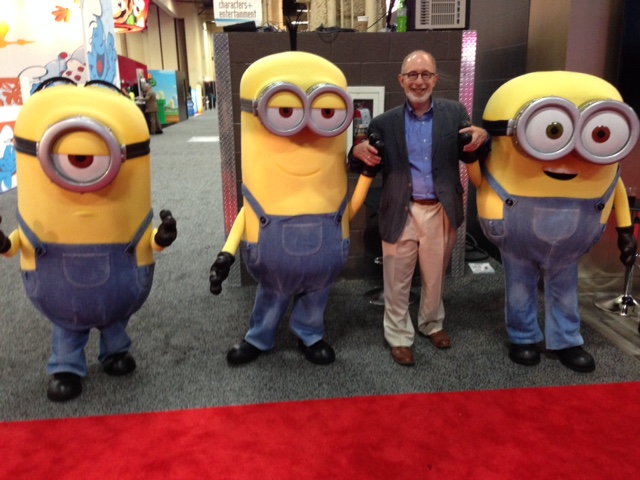
Nice Touch. Kudos to Advanstar for adding a “character parade” the opening day of the show. Several dozen characters wound their way slowly through the aisles, making for plenty of smiles and some neat once-in-a-lifetime photo ops. On their own, The Minions were especially popular at Universal’s booth, while the Teletubbies made an appearance at the LIMA Awards festivities.

The character parade made for some strange bedfellows.

LIMA General Counsel Greg Battersby and mystery guests at the LIMA Awards ceremony.

Your humble reporter befriends the Minions

Your humble reporter befriends the Minions.

What I Learned At Licensing Expo 2015, Part II: Beyond ‘Device-Agnostic’

The younger the consumer the less he or she cares which device they watch or listen to. It’s been apparent for several years now that they don’t think in terms of computer, stereo, smartphone, TV, radio, etc. They want their content on whatever device is convenient at the moment.

But they also don’t think in terms of film or a game or a traditional TV show or a Netflix or YouTube or other video. It’s all entertainment to them, a fact that is underscored by the way PBS Kids emphasizes digital games for its preschool shows; movies deliver trailers a year out and prolong the life of a release through, again, games and other online extensions; or TV shows extend their season with mini-episodes online.

All of this is cause for a wholesale re-thinking of how all forms of entertainment are marketed — let alone how entertainment consumption is measured.

A complaint that came up repeatedly at Licensing Expo this year from toy companies, movie studios, TV and video networks, and other IP owners, and which I’ve heard from people in music and other entertainment sectors as well, is how difficult it is to measure the popularity of a given movie, TV show, music recording, game or other piece of “content” across even the major platforms.

Whether YouTube or Netflix or Amazon or Facebook or Twitter or Spotify or… the owner of a piece of intellectual property has to go into each platform’s analytics  independently, with no shared interface to simplify the process.

For marketers that means learning a host of analytics systems when all they really want is “the numbers” and probably aren’t statisticians. For large companies with dedicated departments that’s not a big issue. For anyone else (and that includes most companies), it is a very big issue indeed.

Is there anything out there that aggregates this wide range of user data across platforms?