Walking The Winter Shows: Toy Fair, AmericasMart & NY Now

BROOKLYN, NY; FEBRUARY 24, 2017—“What did you see that was new?”

“What’s exciting?”

Those are the questions anyone who has walked a trade show of any kind is asked in the aisles and at cocktail receptions once the floor closes. And hardened show attendees, even though they, too, ask those questions, know the answer: “Not much.” Not so, I say. It just takes a little time to reflect.

Walking NY Toy Fair last week, and AmericasMart Atlanta and NY Now, known by most as the Atlanta and New York gift shows, respectively, isn’t about “new” or “exciting.”

Walking such shows is instead an opportunity to:

√ Soak up innovative design and product development trends;

√ Evaluate the latest technology advances — and how they’re being integrated into traditional products;

√ See the color palettes coming over the next few selling seasons across multiple product categories;

√ Discover the tweaks that build on success; and, equally importantly…

√ Bear witness to concepts/products being tested for retailer interest that will never make it to market. These, too, are instructive.

Here, then, are the themes and random observations from a month of shows. Some of these products already have some licensing supporting them; many of the others have clear licensing potential because, while the technology (in the broadest sense) can be copied, licensing the right properties for it offers differentiation.

Tech, Tech Everywhere

One striking trend is the integration of textiles including bedding and rugs, as well as floor coverings, wall hangings, and other decorative accessories, into app-based games and stories. Note: The classic “RC” radio-controlled toys are often though not exclusively now controlled by apps. This segment includes:

  • Apps where augmented reality stories are controlled by aiming a smartphone or tablet camera at a map or map-like image (a forest, say) which are increasing in number. Tilt’s SpinTales (owned by textile manufacturer Welspun) delivers video, narration, and activity suggestions when a device’s camera is focused on an illustration matching one on a Tilt-designed duvet cover or rug. The app itself is free. This is the tech-enhanced version of the gaming format used by Charlotte, NC-based Playtime Edventures, which designs sheets that are used as gameboards for non-electronic games such as checkers.
  • Virtual reality goggles and a small app-driven drone with a camera are part of Spin Master’s latest add-ons to the Air Hogs DR1 Racing line. The goggles center the user inside the action, which is the next step after “watching” the action on a tablet or phone.air-hogs-vr-game
  • Decalcomania, which is primarily known for stick figure family-on-board car decals as well as traditional licensed decals, is introducing wall decals that are essentially gussied up QR codes which, when activated by your device, take you to video footage or games.
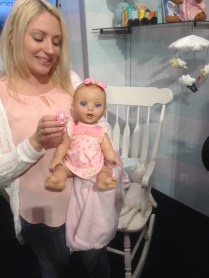
    • Luvabella is a life-like doll, also from Spin Master, that was, frankly, a little creepy in its responsiveness (and its eyes). The doll stretches when waking, laughs when you tickle it, makes appropriate sounds when eating, and expands vocabulary as the child playing with it grows. luva-bella It is NOT internet- or Wi-Fi connected, a problem Mattel encountered with its talking Barbie a while back. Note to Spin Master: Luva Bella is a wine bar and bistro in Lowellville, OH, for which Luvabella the doll is definitely underage.
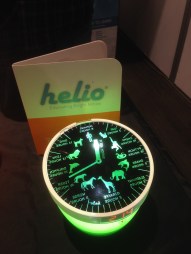
I can’t say as I’ve seen the “killer app” in augmented or virtual reality, but that will come in time, no doubt. And sometimes classic technology can be executed with a fresh spin. Helio’s light projector, for example, exchanges the typical stars projected on the ceiling of a child’s room with interchangeable word games and other educational material. The company is now producing projectable discs featuring Mickey Mouse for its lamps for sale exclusively in Disney theme parks and stores.helio
Collectibles

Holiday season 2016’s must-have out-of-stock toy was Spin Master’s Hatchimals. Now that they’re in-stock, they’re spawning not only new editions in their own line, but copycat versions such as Beverly Hills Teddy Bear Company’s Surprizimals. Similarly, Disney’s success with stackable Tsum-Tsum plush finds Ty featuring Teeny Tys very prominently.teeny-tys

Generally, interest in “collectible” small toys (add Spin Master’s Chubby Puppies, which may be politically incorrect, and classics such as Hasbro’s My Little Pony and Polly Pocket, among many others) is perennial, though I suspect hitting a peak for the moment. As a trend, that will rest and come back in some new iteration in 6-7 years.

Chalk It Up

Chalk boards and chalk writing had been a trend for a number of years at the gift shows, though that seems to have plateaued and perhaps fallen off. However, there are new versions of chalk toys for kids that are interesting.

Chalk of the Town, launched in August and seen at NY Now, offers t-shirts with markable and erasable/washable chalk boards embedded. The shirts come with special markers. Licensing opportunities seem like a natural fit for a chalkboard in the shape of, say, Mickey/Minnie ears or a Mustang. [Note: Photo removed at request of the company in Oct. 2019.]

Jaq Jaq Bird started 12 years ago with a foldable chalk mat on one side, placemat (for eating) on the other. Its latest offering, seen at AmericasMart, are artist-based Chalk Color It Books — soft-sided books evoking Van Gogh, Degas, and others. The pages have outlines based on the original art which can be filled in with the company’s Zero Dust Chalk. Again, easy to see licensed applications here.

Color Me Bright

AmericasMart and NY Now are notable for the color palettes that jump out at you. The photos here tell the story:

Bumkins and Avanchy are among those selling brightly colored silicone “plates” and mats for young children. Bumkins is a long-time licensee of DC, Dr. Seuss, and others, and Avanchy uses the silicone for the suction bottom and non-dishwasher-friendly bamboo for the plates and utensils. Baggu offers a range of reusable shopping bags. Color Cords specializes in colorful electrical cords, fabric wire, and other accessories.

The Miscellany

I started by talking about fabric and technology, but fabric is a running theme here with its own “technologies,” what with wearable chalk boards you can throw in the wash and others that fold, crinkle, are heat-activated, and so on. Examples include Palomar’s “Crumpled City” cloth maps; Mikabarr’s heat-activated polymer fabric that folds for lamps (and other fabric types that fold in unique ways), from Israel; Uashmama’s washable paper food bags, aprons, cosmetic cases, and more, out of Australia.

Sometimes I come across products that have been around that I simply haven’t seen before. Ciao! Baby’s Portable High Chair folds the way beach chairs do, and is about the same weight. The Louisville, KY-based company has licensed versions for 49 schools via Collegiate Licensing Company (CLC) and the product has been on the market for about five years. The new accessory: a clip-on lightweight umbrella, thus far only with the Ciao! Baby logo but which attaches to the licensed high chairs, too.

What’s new? What’s exciting? Those are questions with no answers in the heat of the moment, coming off the floor in that hazy state I’ll call “convention head.” But a little reflection always brings new ideas and perspectives.

Need help refining fresh marketing and licensing concepts? Finding brand extension opportunities? Conducting competitive research to define the “white space” your business can occupy? Contact me at ira@iramayer.com.
What’s Craftsman Worth Without Sears? What’s Sears Worth Without Craftsman?

NEW YORK, NY; January 6, 2017—Is Craftsman worth anything without Sears? Stanley Black & Decker is placing a $900 million bet the answer will be yes.

And a corollary question: Is Sears worth anything without Craftsman and sister store brands Kenmore and Die-Hard?

It’s no surprise that Sears has sold its Craftsman brand of tools. It will be no surprise when Kenmore and Die-Hard are sold too. Rumors about those possibilities have been circulating for 6-7 years now as Sears has sought different pathways to monetize those brands beyond its stores. Sears has tried licensing them, but the retailer needs cold hard cash now to satisfy vendors and other creditors that it can stay in business and meet its obligations. Hence, a sale.

screen-shot-2017-01-06-at-2-02-00-pm

But Craftsman and Kenmore are so associated with Sears that it could be a challenge to Craftsman’s new owner (and a potential new Kenmore owner) to move beyond Sears’s rapidly closing doors. [Concurrent with the sale of Craftsman, Sears announced it is closing another 150 stores.]

Why am I so skeptical? In 2009, as then-owner and publisher of Research Alert, Marketing to Women, The Licensing Letter and other newsletters, I published a research study, “Private Label Consumers: Brands They Know, How They Shop & Which Media Reach Them.” We surveyed 200 women to see if they knew which store brands are sold by which retailers.

Across more than 40 apparel, food, and other store brands, consumers correctly aligned brand with store 20% of the time and got it wrong 20% of the time. The other 60% thought they knew, but were wrong.

There were two standout brands, though, that skewed the results among that first group: Consumers knew that Craftsman and Kenmore were Sears brands 78% of the time. The closest runners up in terms of consumers identifying a store brand with the right store: Great Value/Walmart (52%), Equate/Walmart (50%), Faded Glory/Walmart (48%), Jaclyn Smith/Sears & Kmart (47%), and Arizona Jeans/JC Penney (44%). The other brands: None garnered better than 25%, and several were in the low single digits.

Yes, the data is eight years old. But Craftsman has a 90-year legacy with Sears. At the time, even 51% of 18-24 year olds knew that association — bested only by the 56% of that age group that identified Kenmore as a Sears brand.

screen-shot-2017-01-06-at-2-03-21-pm

Stanley Black & Decker is leveraging its bet somewhat, paying $525 million on closing the acquisition, another $250 million at the end of year three, and annual payments of 2.5% of sales through 2020, 3% through January 2023, and 3.5% thereafter, according to WWD. “Sears in turn will receive a license to continue to sell Craftsman products that will be royalty-free for the first 15 years, but will have to start paying a royalty payment of 3% after year 15. . . Sales not connected to Sears’ distribution channel were about $200 million over the last 12 months,” WWD reports, while raising further questions about what happens to those payments if Sears isn’t around anymore.

The mega-concern of every retailer out there today is differentiation (OK, and providing a seamless online/brick & mortar experience for its customers). Craftsman has been the best kind of differentiator for Sears for 90 years. Will it have the same cache when it’s widely available? Will it still drive people to Sears? Stay tuned.

Fearless Forecast 2017:The Need For Speed and Other Challenges/Opportunities

NEW YORK, NY: December 19, 2016—I’ve been formally asking marketers about the challenges and opportunities for the year ahead at least since 1988 (before that if you want to limit it to music, home video, and video games). And I’ve been fashioning the responses into an annual (more or less) Fearless Forecast ever since.

Truth is the answers haven’t varied much over the years. For the licensing community in particular, the overriding challenge: Securing the right retailers for new and old licensing programs. The opportunity: Hitching onto the Next Big Thing (challenge: before it’s too late).

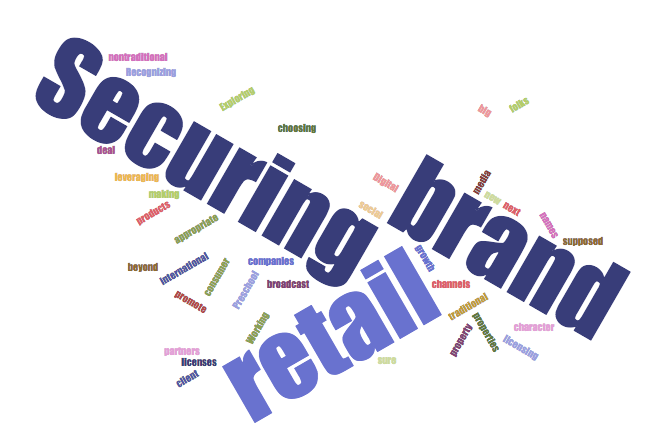
The word clouds here sum up this year’s survey responses as well as the longer-term themes, and even give voice to some of the more existential concerns (e.g. “Is licensing still the right nomenclature to describe the business?”)

challenges-2017
Licensing Challenges 2017
opportunities-2017

Licensing Opportunities 2017

Not wanting to prejudice responses, I deliberately did not ask about the implications of the U.S. election and growing nationalist sentiment in many parts of the world. Interestingly, no one brought those factors up unaided.

In conversations, however, when asked, it is clear there is concern about potentially stricter trade laws and how they might affect deal-making. Will IP owners and manufacturers hold off on some decisions — especially as they relate to B and C properties — until the dust settles and we have some direction? (Not a new phenomenon, even when there aren’t trade questions on the table.) Will there be greater focus on “made here,” in terms of origination of IP as well as manufacturing, wherever “here” may be?

More challenges:

  1. Closing licensing deals takes six months at the very short end of the spectrum, with 12-15 months an unscientific median.
  2. The move to “fast retail” that is spreading beyond apparel, challenging traditional licensing models.
  3. See #1 and #2 above, and note the inherent conflict.
  4. Managing expectations. There are very few seven-figure (let alone eight-figure) advances on licensing programs, and with the exception of a handful of high-profile entertainment and sports properties, precious few that will generate retail revenue of $10 million+ annually, certainly not in Year 1 or 2 shy of some major fad that would likely be short-lived. Yet IP owners new to licensing — and sometimes folks experienced in the field — invariably set those goals, only to be disappointed or to fail.
  5. Figuring out who to push off the shelf in order to get on the shelf. It’s the most elementary question for any new licensing program. Even in the age of “unlimited shelf space” online, the fact is consumers go for the handful of best-sellers. As in traditional brand marketing, it’s the #1 and #2 in a category that account for by far the greatest percent of sales.

Consider: In a pre-Christmas Target tour, looking at licensed properties, close to 10% of the toy section was given over to Star Wars, and just shy of 5% for Marvel. Paw Patrol, Teenage Mutant Ninja Turtles, even Shopkins, one of this year’s hottest girls’ offerings, were about 1% each.star-wars-at-target-12-16

More opportunities:

  1. Speed is of the essence. See #1, #2 and #3 above! The winner is he/she who can “turn it around” while the property is still hot — goes for the IP owner AND the manufacturer — and that can keep refreshing the assortment on a 3-6 week cycle rather than quarterly or semi-annually.
  2. Be realistic. See #4 above. Always best to exceed expectations.
  3. Giving retail the differentiators it needs. Not just a single “exclusive” SKU, but a program.

Here’s to 2017’s numbers being better than 2016’s. And to your own participation in marketing and licensing being more fun, more productive, and more rewarding in the New Year!

Let’s Prognosticate

screen-shot-2016-12-07-at-2-43-01-pmBROOKLYN, NY; December 7, 2016—Here’s a two-question survey to help assess where the licensing and merchandising business is headed in 2017. Please respond by December 12th; I’ll post an analysis plus my observations later that week.

If You Don’t Like the (Licensed) Luxe of It…

If it looks like licensing, tastes like licensing, smells like licensing and feels like licensing, is it licensing? Not necessarily for a range of luxury brand collaborations and partnerships, says Unity Marketing’s luxury marketing guru Pam Danziger in The Robin Report.

In the article, Pam and I explore the question in the context of examples including Kathy Ireland’s furniture line with Raymour & Flanigan and Sarah Jessica Parker’s partnership with Manolo Blahnik to develop a shoe collection exclusively for Nordstrom—cases where the celebrity often has an active role in product design and development.

screen-shot-2016-09-28-at-5-44-05-pm“Some [other] collaborations are short term,” notes Pam. “Capsule collections that many fashion designers do with off-price brands like Target and H&M—while others are more substantial, like Apple and Gucci, or Tag Heuer, Google, and Intel for smart watches. Other examples are Valentino and Havaianas flip flops; Tory Burch and Fitbit wearables; Beats headphones by Dre and Fendi; and Cynthia Rowley and J.Crew wetsuits.”

Click here for the complete article, including many more examples of unique luxury market collaborations and partnerships.

And if you’re looking for competitive research on licensing and branding — luxe or otherwise — contact me at ira@iramayer.com.

Walking NY NOW: Handcrafts Exhibitors Take Fresh Look At Discarded, Recycled, Reclaimed Materials

SEPTEMBER 1, 2016; NEW YORK, NY—NY NOW is a hybrid gift and home accessories show with a nod toward handcrafted (or maybe better thought of as “small batch”) goods. I concentrated on the latter this time around at the Javits Center here, because sometimes the handcrafted goods are harbingers of things to come from the mass producers or inspire fresh thinking about staid licensed categories. That’s where stealing smart begins.

One of the trends gleaned here: Fresh takes on incorporating discarded/recycled/reclaimed materials. This movement waxes and wanes, without ever totally disappearing. But I came across some innovative examples:

Stacey Lee Webber works with coins and found metal objects to create art pieces. Pictured are what she was showing at NY NOW, including a framed display of Abraham Lincoln busts cut from pennies and of nickel buffalo roaming. Not on display but worth taking a look at on her website is a chainsaw fabricated from pennies. Looks like it even works.

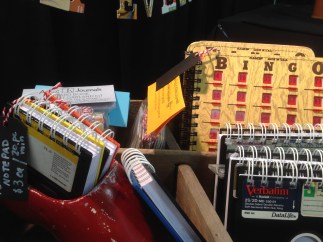
Attic Journals uses old book covers, bingo cards, floppy disks and other items as covers for its journals, and incorporates parts of books and old library “book due” cards for its jewelry.

NY NOW journals w:recycled covers

People for Urban Progress (PUP) makes “goods for good,” rescuing “discarded materials [and] redesigning them for public benefit” in Indianapolis. They started in 2008 making messenger bags and other items with material salvaged when the RCA Dome was torn down. The bags, in particular, have a great distinctive look and, if you will, vibe. Product sales benefit various projects the non-profit supports as well as local artists, designers, and others involved in creating them.

Swell Fellow is a Montreal-based company specializing in high-end ties and bow-ties for men (there are a few selections au feminine), some of which feature Scrabble tiles, keyboard keys, and miniature toy pieces such as cans of paint or a Coke bottle. A few ties have a pocket to accommodate a cell phone as part of the fashion accessory.

This one is only tangentially about recycling (“Give old clothes new life!”):

Patricia Vogel and Dominique Serrano’s Button makes . . . buttons. It was late afternoon and I’m thinking snack — when I see this display that looks like very artsy macarons. Well, they’re buttons, hand made in Chile, and they’re sold individually as brooches and buttons, or in pairs, with magnet backing, to use to tie a scarf or spiff up old clothes.

OK, not as good as a macaron, but refreshing in its own way.

Need a fresh pair of eyes to update your competitive positioning? Contact me here.

Haven’t Had Your Fill Reading About Pokémon GO Yet? Try This…

Following up on why there won’t be a “next” Pokémon GO, as if there hasn’t been enough written about it:

  1. Book and toy as well as mass merchants and other specialty retailers, are not surprisingly reporting vastly increased demand for Pokémon merchandise. See Publishers Weekly for bookseller (and bookstore café managers’) comments on how the “New Pokemon Game Takes Bookstores By Storm.”
  2. While there have been reports that Nintendo is signing Pokémon GO licensing deals “left and right” (see NY Post), that is inaccurate on several counts: First, Nintendo doesn’t control the rights, The Pokémon Company (TPC, of which Nintendo is a part owner) does. Screen Shot 2016-07-18 at 6.44.54 PMSecond, The Pokémon Company signed its deals for the 20th anniversary of the property last year and marked that occasion with a Super Bowl commercial this past January. So while the degree of success of the app was unanticipated, the fact that there would be renewed attention on the property, which Millennials grew up with, was not.
  3. The Pokémon Company London office covers all of Europe, where poster and other merchandise licensee GB Eye’s Max Arguile relates to me his own conversation with the company. “Given that there is no difference between the artwork of Pokémon and Pokémon GO,” Arguile says TPC told him, “it makes no sense for them to spend time negotiating licenses that would effectively replicate what they already have in the market (and either making licensees pay twice for the same thing or annoying them by appointing a competitor). The only difference in artwork is the addition of GO to the logo. If [their position on not licensing separate Pokémon GO Images] changes they will let us know but right now they are busy fielding multiple calls every day from all the major retailers — this is where the real money is, not in adding licensees. [In the wake of the Pokémon GO Phenomenon,] Tesco, Asda, Sainsbury, Primark, Debenhams, Matalan and M&S have all ordered big apparel ranges for Q3/Q4 2016. This will be achieved by print-on-demand. Other categories, such as bedding are going into most of the same retailers.” Arguile adds that TPC forecasts “some big collaborations in 2017.”
  4. The most recent estimate of worldwide retail sales of licensed Pokémon merchandise is for 2014 at $328 million, according to The Licensing Letter. I estimate that in 2015 the property would have been down somewhat as is typical prior to an event such as a 20th anniversary. Published reports of $600 million seem way out of range.
  5. Publishers Weekly isn’t the only non-game trade magazine reporting on Pokémon. Try this one from Billboard, about the characters landing in music business offices. Not to mention the fact that the New York Police Department issued Pokémon GO Safety Tips, sent by email to subscribers to its various alerts as well as posted on its website.
  6. While Millennials are the core audience, even among my boomer contemporaries, the topic literally came up in every dinner conversation the past week, and a number of friends have downloaded and played with the app, though they’re not going out in search of merchandise. (At least not until this filters down to their grandchildren…)


Why There Won’t Be A ‘Next’ Pokemon GO

NEW YORK, NY; July 12, 2016—Here’s the Pokemon GO story — “How Pokemon GO Took Over The World And Why There’s No Point In Ripping It Off,” a commentary by The Wrap’s Phil Owen — you need to read if you’re wondering how to cash in on the craze.

Screen Shot 2016-07-12 at 3.20.40 PMFor years I’ve been warning people that building their business plan on being “the next Beatles,” “the next Disney,” “the next Andy Warhol” is to set yourself up for failure. If you do that well, great — and hopefully you can be prepared for how to prolong the life of the property or project. But most business propositions aren’t going to hit the stratosphere.

Years ago I asked Clive Davis, the legendary music business impresario and then Arista label-head, how surprised he was when the single “There Goes Another Love Song” off the Outlaws’ debut album was a hit “out of the box.” “Not surprised enough not to know what to do.”

It was a brilliant answer that I’ve quoted often, and that has informed much of my research into and thinking about pop culture over the years.

I don’t agree 100% with Owen: I suspect there will be a market for other Pokemon GO-like augmented reality games. They just won’t be the phenomena that Pokemon GO is, and as long as the creators don’t scale up for being “the next Pokemon GO” at least some will be viable.

The critical question is how long Pokemon GO can be sustained and, for Nintendo, whether it will have a salutary affect on sales of Nintendo game systems, games and licensed merchandise. (See my recent post, “Sustaining Licensed Properties In A Multi-Platform Universe.”) Generally, the faster a fad takes off, the faster it crashes.

FYI, if you’re a gamer of a certain age thinking it’s time to cash in on your dusty classic Pokemon collection, eBay had 440,296 Pokemon items available when I just checked, 95,548 of them trading card collections.

Need competitive research? Someone to bounce marketing strategy off of? To educate corporate officers about licensing? Contact me at ira@iramayer.com.

Licensing Expo At 35,000 Feet: Sustaining Licensed Properties In A Multi-Platform Universe

EN ROUTE, LAS VEGAS, NV to NEW YORK, NY; June 23, 2016—Over 26 years attending Licensing Expo, whether sitting down to interview people or walking the aisles, I always get variations of the same question (especially from exhibitors who rarely get to leave their booths): “What are you seeing on the floor?” “What’s new?” “What’s hot?”

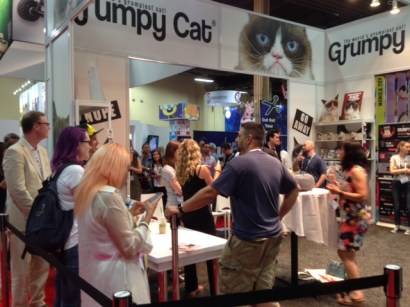
The truth is, when you’re at the show, the elaborate exhibits, the characters walking around, the noise, the constant visual bombardment make it difficult to process what you’re experiencing beyond realizing that the longest line at the show was to have your picture taken with Grumpy Cat (except for those of us allergic).

Grumpy Cat line

Smiling with Grumpy

So to all who asked me that question this year, while I was in my tradeshow stupor, and to those just wondering, 35,000 feet on the way home offers the needed distance to pull some thoughts together.

The key theme for me: Sustainability has dual meanings. One is environmental, which is subject for another time. The other is about sustaining the life of a property in a digital age. I’m going to focus on the entertainment/character/gaming worlds here, but that subject is top of mind for every brand, fashion, sports, art, and other licensor, manufacturer, agent, and other player as well.

Traditional media still count, certainly to companies rooted in it, but the fact is many of the digital content producers don’t yet understand the importance of multiple platforms, including the traditional ones.

“Linear still has the reach and consistency you need” to support a licensing program, Cartoon Network’s Pete Yoder told me. “But we also know mom hands off [he moves his smart phone from one hand to the other] to the kids.” Three key changes in the digital age:

  1. “We’re developing content specific to each digital medium. It’s based on the same IP but we’re not just re-editing 11-minute programs to 90-seconds.”
  2. “We’re ordering the number of episodes we need by medium from the beginning.”
  3. “Years ago you needed 6 months to a year after a program was a hit to get a licensing program underway. Now the question is, ‘When are you launching the first access to the brand’” via any medium.

At Activision, the “traditional” medium is games, and that — just as obviously as TV is for Cartoon Network — continues to be the core. But the news at Activision is a Netflix commitment to two seasons of a Skylanders Academy series. “Our audience is 6-12, with a real sweet spot of 6-9,” the company’s Ashley Maidy noted. A linear program, for her, has the potential to “bring new kids in — younger kids whose older siblings know the game, as well as others who just haven’t been exposed to it at all. . . .It’s a marriage of digital product and multiple platforms.”

The transformation of Skylander across platforms has proven easier than for Call of Duty, but a film is in the works for that, as well.

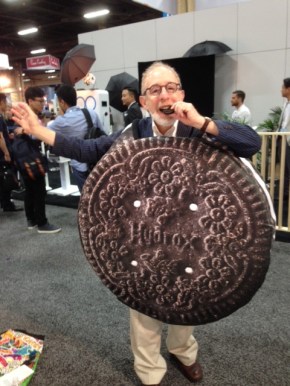
IM in Hydrox suit

Your humble correspondent stopping for a little food for thought.

Activision’s challenges — and a common refrain at many companies: “We still have to educate buyers and retailers who are tradition-bound that our customers aren’t watching TV. And with no ratings for Netflix, how do you measure success?” [Aside: One of the most promising areas to Activision founder Bobby Kotick, Maidy says, is eSports, which Kotick believes — and Activision will be playing an ever-greater role to accomplish — could be as big as the NFL in five years. Why not think big?]

Both Yoder and Maidy agreed with me that even two years ago if someone had offered them Netflix as an outlet for a series they would have turned up their noses. Not anymore.

That said, hyperbole from the digital world doesn’t really help on the measurement count, in part because it feels as though (not just at Licensing Expo, but in the “wider world”) that the digirati don’t really understand what’s important to know. They can measure all sorts of things, but those numbers don’t necessarily translate to something the IP, ad, or licensing worlds can use.

Consider Paladin Software’s James Creach, speaking as part of the Digital Licensing Summit program at the Expo, who observed that “the Super Bowl is watched by 112 million people but 1 billion people are active on social media in a month.” Well, an event watched simultaneously by 112 million people — roughly one in three Americans — is a very different story than a billion people spread across almost as many messages of all sorts. The latter isn’t unimportant, but the comparison does no favors in selling the medium.

I didn’t get to speak with anyone from Youtube, but their booth looked like a lost opportunity. Clearly a major player as an outlet for new IP as well as for creating new channels for existing programming, the company had a huge space. But from the outside all one saw was a small sign with some of the properties named. No effort to educate what the properties are, where Youtube fits in, how it translates into consumer products or even just to pique interest. I don’t think I’m alone among show attendees (OK, of a certain age — but younger as well) in having heard of only a very few of the properties named.

I’ll get off my soapbox in a moment. But coming from the print publishing world, one of the things I’ve watch many “digital-only” publishers discover is that at this point in time, to satisfy advertisers, they still need print. Similarly, digital video celebrities or others will find it difficult to sustain their fame or develop long-term careers without multiple platforms — and I don’t mean just multiple social media. Just as traditional media have been forced to embrace new media, so new media will need to embrace the old. Tyler Oakley, who is part of the Dreamworks/Awesomeness  stable, gets it: he’s out there touring with a live show, there’s a documentary, AND he keeps up his video and social media output. Rock and roll, watch out. [Commented one music merchandiser: “We survived superheroes and Star Wars. Music is trending up.”]

Most trenchant observation by a newcomer to licensing at the show, though: John Haugh, the 3-months new CEO and President of Iconix, at a reception for Peanuts licensees: “I know many of you would like a Peanuts movie every year. We would too, but nobody does a movie every year, not even Star Wars. And I want to remind you that many of you have done very well with Peanuts for 50 years before there ever was a movie!” Talk about sustainability!

What Won’t Be Obvious Walking the Floor at Licensing Expo

NEW YORK, NY: June 15, 2016—Here are some of the questions I’ll be thinking about as I walk Licensing Expo in Las Vegas next week:

  1. How will Disney replace the incredible revenue stream that Star Wars, Marvel, and Frozen merchandise have generated in the past three years? (Notes: If historic trends hold, the second Star Wars film in the current series is not likely to generate the same merchandise sales as the first. As for Marvel, superheroes are cycling out in a natural pattern. It will be another generation before that genre is ripe for the next go-round. Superheroes won’t disappear, but they won’t have the same impact on merchandise sales for a while.)
  2. Which new digital celebrities or other properties will still be popular when their licensing programs hit retail?
  3. Which ones that were hits last year are having an impact now?
  4. What are the success factors for digital properties vs. those that emerge from traditional media? Toys? Brands? Art? Sports? Fashion?
  5. Will more niche properties get a foothold, thanks to the fragmented media and retail environments? Or is “the long tail” a mirage?
  6. Does the celebrity-based capsule collection trend have legs? (I expect to see more and more of these. Good differentiators for retail, and good testing ground for broader programs.)
  7. Which agencies will raise the capital to acquire brands (or stakes in brands) of their own, reversing the business model of Iconix, Authentic, Sequential and the not-so-little engine that does…PVH?
  8. What would brand ownership do to the agency business model, which is already under pressure to add services outside their core expertise, not to mention to compete for consulting revenue by representing manufacturers?
  9. Speaking of Iconix/Authentic/Sequential: Is that business model viable long-term (again, works for PVH, which has been at it for years)? Where are the fault lines, doubters?

And my questions for you:

Need competitive research for your licensing program? Looking to benchmark against comparable brands, products, or properties? Seeking valuations for banks or legal proceedings? I can help. Email me at ira@iramayer.com and we can set a time to meet Monday (the day before Licensing Expo), Tuesday or Wednesday morning in Vegas.

Need to educate new employees or upper management about licensing? I’m teaming with licensing consultant Karen Raugust to offer executive briefings and training workshops for corporations and other organizations involved in licensing. Content is customized to suit your needs. Visit www.iramayer.com/education for details, or contact me as above to set up a meeting at the show (or after).

Want to know how to work with licensing agents and consultants? Attend the LIMA-sponsored Licensing University session I’m moderating with Gary Caplan (Gary Caplan, Inc.), Carole Postal (CopCorp and Knockout Licensing), and Ilana Wilensky (Jewel Branding & Licensing). The session is Tuesday, June 21, 11:15 a.m. – 12:30 p.m. in Tradewinds F at the Mandalay Convention Center. (Registration required.)

Or just be in touch so we can say hello, clink waters in the hall, and you can let me know what your questions are!

Have a great show — and watch this space for my reports from the floor.