Driving Living History Forward With National Geographic Consumer Products
ACROSS THE UNITED STATES; July 17, 2017—Rarely do you literally drive head-on into the challenges and opportunities of licensing as my wife Riva and I did this summer.
The property: National Geographic, founded in 1888.
Tracing the route: Start with an elaborate, beautifully orchestrated presentation at Licensing Expo in Las Vegas, an early stop on what turned into a 9-week cross-country road trip visiting primarily national parks and forests.
Add 45-minutes the next morning with a bleary-eyed but no less enthusiastic and articulate Rosa Zeegers, who I first met during her 12+ years in licensing and business development at Mattel, and who is now EVP Consumer Products & Experiences at National Geographic Partners, the for-profit spinoff of the National Geographic Society that was formed two years ago by 21st Century Fox (which owns 73% of NG Partners) and the Society. A percentage of all profits from the operation benefits the Society.
But our paths didn’t stop crossing in Las Vegas, and it was those additional crossings that drove home, so to speak, so much of what was presented at the summit and that Zeegers and I discussed.
The talk of Yosemite National Park, where we happened to be on June 3rd, was how rock climber Alex Honnold scaled the 3,000-foot El Capitan without ropes in a record three hours and 56 minutes that morning. Who documented the event? National Geographic.

Heading north to Redwood National and State Parks, who had documented the height of the tallest Sequoia sempervirens — better known as a California redwood about 10 years ago? National Geographic.

Who publishes the detailed trail map to Olympic National Park (among many others) that our rock-climbing son-in-law lent us? National Geographic.


Throughout our trip, which covered about 10 parks and forests in the U.S. and more in Canada, references to National Geographic cropped up repeatedly. And therein both the challenges and opportunities.
Ubiquity? Check.
Respect? Check.
Name and logo recognition? Check.
Your grandparents’ magazine? Check.
Dusty stack of old National Geographics in the basement or attic? Check.
You get the idea.
At its Vegas presentation, which served as a summit for existing licensees but also included select potential licensees the company was hoping to impress and bring into the fold, the emphasis was on National Geographic’s efforts to attract millennials. Touting its status as a No. 1 social media brand (the No. 1 title seeming a bit fabricated, based on “the number of social actions” such as likes, shares, comments, and retweets over a three-month period in 2015, as measured by Shareablee), spotlights the divide between the substantially older group that follows the classic print magazine and books, and the younger audience for the TV and online offerings. Theme-based issues of the magazine such as those on gender, or on Mars, have skewed younger than the traditional audience, and more of these are on the boards.
But bridging that gap is the challenge that hangs over all future opportunities — opportunites that are varied, numerous, and not limited to licensing.
For example, Zeegers says the company is “moving up [the] vertical integration” ladder, having recently purchased Global Adrenaline, a tour operator it had worked with on a licensing basis in the past “so we earn more than a royalty.” National Geographic has 16 partners in the travel segment, as well as lodges. That travel group represents an effort that was started 17 years ago and which has shown 20% annual growth over that period. Up next for travel: Adding river cruises.
The company plans on “building a kids franchise” with various potential spinoffs. “Millennial parents want kids to play with toys that add substance, that pull them away from the tablet and educate — but are still fun,” says Zeegers.
Focus will also fall on National Geographic Live, e-commerce, books, and, of course, licensing, among other areas under Zeegers’s purview. Outdoor fashion and footwear, she suggests, are organic brand extensions which Zeegers sees as an opportunity “for a retailer to grow together with us.”
The timeline for new licensing agreements? Two years, with a two year option, and assuming a year for negotiating and product development. “What’s five years in 129?” Zeegers asks with a smile.
The franchise she is looking to drive in new directions, to younger audiences, is living history. After 12,124 miles I can vouch first hand.
P.S. The photos accompanying this story are Riva’s and mine, not National Geographic’s; the video link is theirs!
Looking to understand the marketplace as you extend your brand or product line through consumer products licensing? Contact me for competitive research at ira@iramayer.com.
What to Look For Between the Aisles and Behind the Curtains at Licensing Expo 2017
NEW YORK, NY; MAY 20, 2017—It’s not the carefully worded polished press releases or the beautifully choreographed licensee summits that generate the “news” of Licensing Expo. It’s in how the companies behind those releases and events complement, contrast and compete with each other that the trendlines can be discerned.
Here’s what to look for behind the booths and between the aisles at this year’s Expo in Las Vegas May 22 (when Licensing University and the summits commence) and May 23-25 (the formal show):
- Digital Properties. Add BuzzFeed, AirBnB and others to the digital celebrities we’ve seen in prior years.
- Speed to Market. The digital environment has made “I want it yesterday” reality.
- International box office. Studios forecast the geographic breakdown of licensed merchandise sales globally based on box office trends. Well, folks, box office outside the U.S. is now often two-thirds of the total. Where would you place your bets?
- Made local. Not just Brooklyn or USA — but local pride is a point of differentiation for all manner of properties and goods.
- Retail consolidation. Store closings isn’t where the story is. It’s the transformation of mall spaces into entertainment environments, the on-going quest for seamless integration of online and offline shopping, and the need to turn the shopping experience (again, online or off) and the products themselves into “experiences.”
- Competing with licensees. Another aspect of the retail story — licensees and licensors are going head-to-head with the retailers they once feared competing against.
- Online/mobile shopping. Corollary to Nos. 5 and 6. Sports — specifically Fanatics — is paving way for other property types. And while Fanatics started as the online seller for most leagues and teams, it’s opening physical locations as well. Outside sports: Keep an eye on what Amazon is up to in bricks and mortar, localizing product selection and rewarding its best customers.
- New wave of anime. More coming on the globalization front.
- Public properties — mass transit following NYPD. This is different than non-profit licensing. It’s working in Australia, the UK, and more.
- Experiences/Services are on the rise. Online “clubs,” touring shows and museum-like exhibitions, hotels. If you can “experience-ilize” it, you’ve got a selling point to test.
- This term has shifted from serious upscale limited editions to mass toys. Are trading cards ready for a comeback?
- Subscription boxes. This is a fad that will play out. It won’t disappear, but there’s a reason book clubs and record clubs went the way of the dinosaur.
If you’re at the show and would like to meet up, contact me at ira@iramayer.com. I’m also moderating the Licensing University session, “The Basics of Licensing,” featuring manufacturers consultant Gary Caplan (Gary Caplan Inc.), and licensing agents James Slifer (The Joester-Loria Group) and Joanne Olds (The Buffalo Works, specializing in representing artists). Here’s a preview of the session, which takes place Monday May 22, 9-11:15 a.m.
Licensing Into The Home
NEW YORK, NY; April 19, 2017—Celebrity designer Nikki Chu posted a piece of wall art on Instagram recently and received 45 requests asking where to purchase it within 10 minutes.

Wall art from Nikki Chu Home
“People are hungry for the instant gratification of buying the products they see online,” Chu said as part of an International Licensing Industry Merchandisers Association (LIMA) webinar today, “The Ins and Outs of Licensing For The Home.” Also speaking were Ilana Wilensky of Jewel Branding & Licensing, an agency, and Greg Wyman, founder and president of The Wyman Group; Wyman initiated the B. Smith with Style brand and today manages (along with Jewel) the Poetic Wanderlust brand designed by Tracy Porter.
Tips from the session:
- The importance of photography to online sales can’t be underestimated, noted Wyman. “Subtlety doesn’t work online,” added Chu.
- Product photos should feature related items, both to put the spotlighted item in context and to introduce the buyer to accessories that will work with it. “The background [goods] aren’t just props,” said Wyman.
- Funnel all products through a brand page, advised Wilensky, as Wayfair and Bed Bath & Beyond do for the Nikki Chu Home brand. That way the consumer doesn’t have to hunt through pages to find each item.

- Fashion brands do not automatically translate to home, according to Wilensky. Similarly, said Wyman, “a celebrity in some other area does not mean you’ll be absorbed into the home world.” Whatever the origin of the IP, all agreed, the brand “has to have significant reason to be in the home.”

Source: Jewel Branding & Licensing
- Unlike fashion, the home market introduces new goods twice a year, noted Chu. This compares to the average 4-5 seasons annually for apparel—not to mention the even greater frequency for fast fashion.
- “If I design a rug,” said Chu, “it takes 4-5 months before I see the first prototype. By the time a product comes in that may be your only shot to get it into the store. [That requires a high degree of] accuracy from the designer for the first go-round because you may not have a second opportunity.”
- Bedding & furniture are the anchors for entering the home market, per Wilensky. “Start with one of those and expand from there. That drives the aesthetic from which you can build the whole collection.”
- “The more licenses you obtain the more difficult it is to maintain a through-line aesthetic across categories,” said Chu. “You want to maintain the integrity of the line but you also have to be able to work with your manufacturers’ design teams so they can get out of the program what they need as well.” Different manufacturers, she added, have different needs that won’t always mesh with the intended look/feel.
- Manufacturers once drove the “aesthetic,” but “today the market demands that the licensor control the look. The licensor needs to initiate ideas,” said Wyman. Today, the involvement of licensor with licensee “is not just for approvals,” adding that the retailer is no longer a third party. “The licensor has to drive the brand with the retailer,” concurred Wilensky.
- Neither manufacturers nor retailers will take designers on unless they have a strong identity – patterns, color combinations, look. “Then you become valuable to manufacturers,” said Chu. “Otherwise they can do it themselves.”
Need competitive research about a market segment you want to enter? Contact Ira Mayer here.
Uncertainty Of ‘Trumponomics’ Shapes Discussions At NYC Licensing Summit
NEW YORK, NY; March 6, 2017—Sequential Brands Group’s Yehuda Shmidman did his best to put a positive contextual spin on the current state of retail at Li©ense Global’s sold out NYC Summit last week. Even if you didn’t agree with all of his assumptions, he made a compelling case for a future (five-plus years from now) in which we will “look at this [period] as the ‘2008 crisis’ for retail,” a reference to the financial collapse of that year.
Shmidman’s boiling down of the root causes of the current status of retail to two key factors — we are “overstored” at 48.4 square feet of retail space per capita in the U.S., compared to 23 square feet for the next largest market, the UK; and the disruptive effects of e-commerce — crystalized the themes that emerged in a day and a half of presentations by licensors, licensees, and agents at the Marriott Marquis in Times Square. (More on Shmidman’s observations shortly.)
Among the themes:
- Impact of Trumponomics — in particular trade agreements and tax structures — on the licensing business.
- A shift away from boomer-centric to millennial-centric shopper behavior, and the commensurate overwhelming challenge of embracing social media and staying ahead of trendlines. (A favorite presentation among Summit participants I spoke with was PepsiCo Creator Carlos Saavedra — yes, that’s his title, and licensing is part of his domain — whose talk centered on implementing experiential licensing-based programs that spur social media use and lead to new business concepts.)
- Continued rapid growth in licensors’ embrace of off-price and club stores.
- “The anxiety [that the] retail store-based consolidation that we are seeing is the tip of the iceberg,” as PVH’s Ken Wyse put it.
- Acknowledgment of limited growth opportunities for evergreen brands (e.g. “maintain” brands at Iconix, including Canon, Waverly, and Fieldcrest; “heritage brands” such as Izod at PVH. Of course both have developing as well as high growth or, as Iconix terms them, “driver” brands).
- Impact of just-in-time sales data which, combined with consumer ability to order instantly, requires substantially greater speed to market and, as Xcel Brands Robert D’Loren put it, “52 seasons a year.”
- Dramatic differences in how companies define “experiential” licensing, which might mean the Kola House restaurant in NYC’s meat packing district for PepsiCo, sponsorship of a half-marathon for Iconix’s Danskin Now brand, or arena eSports events for Activision Blizzard.
- Near-impossibility of countering counterfeits in many markets.
‘Trumponomics’ Trumps the Conversation
“How will Trump changes impact global trade?” PVH’s Wyse asked. Some were more uncertain than others of how trade policy will shake out. Robert D’Loren of Xcel Brands (and the financial co-founder with Neil Cole of Iconix who had previously run the retailer Athlete’s Foot) was the most emphatic. Having lobbied congressional offices in Washington, DC the prior day with the American Apparel and Footwear Association, he was convinced “the border tax will become law. We were arguing to phase it in to give us some time.”
Speaking of brand holding companies such as Sequential and Iconix, that specialize in licensing out all manufacturing, equity research analyst Eric Beder, of Wunderlich Securities, wasn’t hazarding a guess as to what the new administration will do on the economic front, but suggested that some of the proposals under consideration could deliver “a new tax structure that could potentially destroy every brand that doesn’t have core,” core being something that they make, market, and distribute themselves. (Interestingly, Iconix’s Dave Jones said earlier in the event that Iconix deems itself “asset –lite; we don’t make anything,” touting that as a positive aspect of its business model.)
Of a potential border tax, Beder adds, “A border tax doesn’t let you account for cost of goods [in your pricing]; and you can’t turn on a dime to manufacture in the U.S. It’s going to be tough for Republican senators in states like Arkansas to vote for.” Unlike D’Loren, Beder said, “I think it won’t happen, but it will keep rearing its head” and keep that state of anxiety high.
Meanwhile, Wyse noted that he’d made the infamous shirt and tie licensing deal with Donald Trump 11 years ago. “At some point, for various reasons, I wound up a member of Mar-a-Lago,” he said. “And recently I ran into the president there. He remembered me, and remembered the deal. We talked, and he was very much on top of the apparel business.”
As for the “2008 crisis for retail,” Shmidman likes to look to the book business, which he said is now “post-crisis,” for inspiration: 46% of book stores are gone, he noted, while in the apparel business, for which 15% of sales are online compared to 10%-12% for merchandise overall, only 7% of stores are gone so far. With the growth of online retailing, he added, “We have to be able to adjust distribution.” To that end, Sequential is increasingly focusing on building digital businesses for its brands. Example: Martha Stewart meal kits, a “pure digital business” that is “growing double digits month to month.” Earlier that week, Sequential had downgraded its guidance for 2017, attributing the decline primarily to weakness in the department store segment.
General Insight
- Off-price retail sales were up 9% 2015-2016, reported Iconix’s Jones. But off-price, discount, dollar, and clubs are “mostly for our ‘maintain’ brands.
- PVH’s Wyse said off-price is “crucial — not for designer brands, though we certainly sell some Tommy [Hilfiger] and Calvin [Klein] at Costco. For our heritage brands it’s vastly expanded. We might have a halo [presence] at Macy’s or Belk. But where off-price might have once been 12% of business for certain brands [it] can now be 20%-40%.”
- “Retailers need to get better at e-commerce. It’s not something we want to be in on our own.” (Dave Jones, Iconix)
- Brand marketers and retailers need to “reimagine shopping, entertainment, and social as one.” (Robert D’Loren, Xcel Brands)
- “PepsiCo is doing something every agent in this room wishes every client did: applying metrics beyond dollars.” (Debra Joester, The Joester Loria Group, which represents PepsiCo). On a similar note, Scott Bannell, recently retired from Stanley Black & Decker (represented by Beanstalk), outlined the four objectives that company has for licensing: Increase brand impressions and touchpoints; please end-users so they buy more core; expand to new channels and partners; and use licensing income to invest in brand-building programs.
- “We are a media company, not an apparel company.” (Robert D’Loren, Xcel Brands)
- “We don’t sell posters anymore. We sell wall art.” (Dell Furano, Epic Rights, which specializes in licensing musical artists)
- “We are one year away from Amazon, WalMart, and Alibaba accounting for $1.5 trillion in sales.” (Yehuda Shmidman, Sequential Brands Group)
- “Retailers don’t want the brand, they want product performance.” (Scott Bannell, Stanley Black & Decker)
- “Don’t think you can give licensing part-time to someone on a team.” (Scott Bannell, Stanley Black & Decker)
- “Wall Street doesn’t like debt anymore, which hit Iconix and Sequential[‘s stock valuations].” (Eric Beder, Wunderlich Securities)
- For subscription box service Loot Crate, “every box has to arrive the same day, so the videos of people opening the boxes aren’t spoilers.” (David Morris, Loot Crate)
- Spirit Halloween’s 1300 stores do “the same volume in eight weeks as [parent company] Spencer Gifts does in a year.” (Eric Morse, Spirit Halloween/Spencer Gifts)
- Asked what licensors can do to help retailer Tesco, the retailer’s Rachel Wakley said, “Talk to us. Walk our aisles. Make sure your licensees sell your brand as well as you do. If you have to call me to ask for feedback about your licensee you’re probably working with the wrong licensee.”
- “If you can’t sell it in a tweet, it’s not good enough.” (Rachel Wakley, Tesco)
- “Let the customer tell you what they want, then be the best to deliver it.” (Rachel Wakley, Tesco)
- “If you’re rotten and toxic on the inside, no amount of makeup is going to cover that up.” (Drew Barrymore, actress and founder of Flower Beauty, a cosmetics brand available exclusively at WalMart, and other companies.)
Ira Mayer, co-director of the Institute of Branding & Licensing at LIU Post University, and former Publisher of The Licensing Letter, conducts competitive research for marketing and licensing companies. Contact him at ira@iramayer.com.
Walking The Winter Shows: Toy Fair, AmericasMart & NY Now
BROOKLYN, NY; FEBRUARY 24, 2017—“What did you see that was new?”
“What’s exciting?”
Those are the questions anyone who has walked a trade show of any kind is asked in the aisles and at cocktail receptions once the floor closes. And hardened show attendees, even though they, too, ask those questions, know the answer: “Not much.” Not so, I say. It just takes a little time to reflect.
Walking NY Toy Fair last week, and AmericasMart Atlanta and NY Now, known by most as the Atlanta and New York gift shows, respectively, isn’t about “new” or “exciting.”
Walking such shows is instead an opportunity to:
√ Soak up innovative design and product development trends;
√ Evaluate the latest technology advances — and how they’re being integrated into traditional products;
√ See the color palettes coming over the next few selling seasons across multiple product categories;
√ Discover the tweaks that build on success; and, equally importantly…
√ Bear witness to concepts/products being tested for retailer interest that will never make it to market. These, too, are instructive.
Here, then, are the themes and random observations from a month of shows. Some of these products already have some licensing supporting them; many of the others have clear licensing potential because, while the technology (in the broadest sense) can be copied, licensing the right properties for it offers differentiation.
Tech, Tech Everywhere
One striking trend is the integration of textiles including bedding and rugs, as well as floor coverings, wall hangings, and other decorative accessories, into app-based games and stories. Note: The classic “RC” radio-controlled toys are often though not exclusively now controlled by apps. This segment includes:
- Apps where augmented reality stories are controlled by aiming a smartphone or tablet camera at a map or map-like image (a forest, say) which are increasing in number. Tilt’s SpinTales (owned by textile manufacturer Welspun) delivers video, narration, and activity suggestions when a device’s camera is focused on an illustration matching one on a Tilt-designed duvet cover or rug. The app itself is free. This is the tech-enhanced version of the gaming format used by Charlotte, NC-based Playtime Edventures, which designs sheets that are used as gameboards for non-electronic games such as checkers.
- Virtual reality goggles and a small app-driven drone with a camera are part of Spin Master’s latest add-ons to the Air Hogs DR1 Racing line. The goggles center the user inside the action, which is the next step after “watching” the action on a tablet or phone.

- Decalcomania, which is primarily known for stick figure family-on-board car decals as well as traditional licensed decals, is introducing wall decals that are essentially gussied up QR codes which, when activated by your device, take you to video footage or games.
- Luvabella is a life-like doll, also from Spin Master, that was, frankly, a little creepy in its responsiveness (and its eyes). The doll stretches when waking, laughs when you tickle it, makes appropriate sounds when eating, and expands vocabulary as the child playing with it grows.
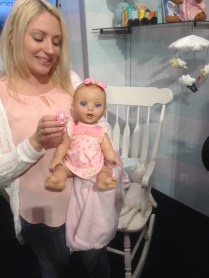 It is NOT internet- or Wi-Fi connected, a problem Mattel encountered with its talking Barbie a while back. Note to Spin Master: Luva Bella is a wine bar and bistro in Lowellville, OH, for which Luvabella the doll is definitely underage.
- Luvabella is a life-like doll, also from Spin Master, that was, frankly, a little creepy in its responsiveness (and its eyes). The doll stretches when waking, laughs when you tickle it, makes appropriate sounds when eating, and expands vocabulary as the child playing with it grows.
I can’t say as I’ve seen the “killer app” in augmented or virtual reality, but that will come in time, no doubt. And sometimes classic technology can be executed with a fresh spin. Helio’s light projector, for example, exchanges the typical stars projected on the ceiling of a child’s room with interchangeable word games and other educational material. The company is now producing projectable discs featuring Mickey Mouse for its lamps for sale exclusively in Disney theme parks and stores.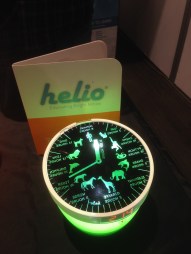
Collectibles
Holiday season 2016’s must-have out-of-stock toy was Spin Master’s Hatchimals. Now that they’re in-stock, they’re spawning not only new editions in their own line, but copycat versions such as Beverly Hills Teddy Bear Company’s Surprizimals. Similarly, Disney’s success with stackable Tsum-Tsum plush finds Ty featuring Teeny Tys very prominently.
Generally, interest in “collectible” small toys (add Spin Master’s Chubby Puppies, which may be politically incorrect, and classics such as Hasbro’s My Little Pony and Polly Pocket, among many others) is perennial, though I suspect hitting a peak for the moment. As a trend, that will rest and come back in some new iteration in 6-7 years.
Chalk It Up
Chalk boards and chalk writing had been a trend for a number of years at the gift shows, though that seems to have plateaued and perhaps fallen off. However, there are new versions of chalk toys for kids that are interesting.
Chalk of the Town, launched in August and seen at NY Now, offers t-shirts with markable and erasable/washable chalk boards embedded. The shirts come with special markers. Licensing opportunities seem like a natural fit for a chalkboard in the shape of, say, Mickey/Minnie ears or a Mustang. [Note: Photo removed at request of the company in Oct. 2019.]
Jaq Jaq Bird started 12 years ago with a foldable chalk mat on one side, placemat (for eating) on the other. Its latest offering, seen at AmericasMart, are artist-based Chalk Color It Books — soft-sided books evoking Van Gogh, Degas, and others. The pages have outlines based on the original art which can be filled in with the company’s Zero Dust Chalk. Again, easy to see licensed applications here.

Color Me Bright
AmericasMart and NY Now are notable for the color palettes that jump out at you. The photos here tell the story:
Bumkins and Avanchy are among those selling brightly colored silicone “plates” and mats for young children. Bumkins is a long-time licensee of DC, Dr. Seuss, and others, and Avanchy uses the silicone for the suction bottom and non-dishwasher-friendly bamboo for the plates and utensils. Baggu offers a range of reusable shopping bags. Color Cords specializes in colorful electrical cords, fabric wire, and other accessories.


The Miscellany
I started by talking about fabric and technology, but fabric is a running theme here with its own “technologies,” what with wearable chalk boards you can throw in the wash and others that fold, crinkle, are heat-activated, and so on. Examples include Palomar’s “Crumpled City” cloth maps; Mikabarr’s heat-activated polymer fabric that folds for lamps (and other fabric types that fold in unique ways), from Israel; Uashmama’s washable paper food bags, aprons, cosmetic cases, and more, out of Australia.
Sometimes I come across products that have been around that I simply haven’t seen before. Ciao! Baby’s Portable High Chair folds the way beach chairs do, and is about the same weight. The Louisville, KY-based company has licensed versions for 49 schools via Collegiate Licensing Company (CLC) and the product has been on the market for about five years. The new accessory: a clip-on lightweight umbrella, thus far only with the Ciao! Baby logo but which attaches to the licensed high chairs, too.
What’s new? What’s exciting? Those are questions with no answers in the heat of the moment, coming off the floor in that hazy state I’ll call “convention head.” But a little reflection always brings new ideas and perspectives.
Need help refining fresh marketing and licensing concepts? Finding brand extension opportunities? Conducting competitive research to define the “white space” your business can occupy? Contact me at ira@iramayer.com.
What’s Craftsman Worth Without Sears? What’s Sears Worth Without Craftsman?
NEW YORK, NY; January 6, 2017—Is Craftsman worth anything without Sears? Stanley Black & Decker is placing a $900 million bet the answer will be yes.
And a corollary question: Is Sears worth anything without Craftsman and sister store brands Kenmore and Die-Hard?
It’s no surprise that Sears has sold its Craftsman brand of tools. It will be no surprise when Kenmore and Die-Hard are sold too. Rumors about those possibilities have been circulating for 6-7 years now as Sears has sought different pathways to monetize those brands beyond its stores. Sears has tried licensing them, but the retailer needs cold hard cash now to satisfy vendors and other creditors that it can stay in business and meet its obligations. Hence, a sale.
But Craftsman and Kenmore are so associated with Sears that it could be a challenge to Craftsman’s new owner (and a potential new Kenmore owner) to move beyond Sears’s rapidly closing doors. [Concurrent with the sale of Craftsman, Sears announced it is closing another 150 stores.]
Why am I so skeptical? In 2009, as then-owner and publisher of Research Alert, Marketing to Women, The Licensing Letter and other newsletters, I published a research study, “Private Label Consumers: Brands They Know, How They Shop & Which Media Reach Them.” We surveyed 200 women to see if they knew which store brands are sold by which retailers.
Across more than 40 apparel, food, and other store brands, consumers correctly aligned brand with store 20% of the time and got it wrong 20% of the time. The other 60% thought they knew, but were wrong.
There were two standout brands, though, that skewed the results among that first group: Consumers knew that Craftsman and Kenmore were Sears brands 78% of the time. The closest runners up in terms of consumers identifying a store brand with the right store: Great Value/Walmart (52%), Equate/Walmart (50%), Faded Glory/Walmart (48%), Jaclyn Smith/Sears & Kmart (47%), and Arizona Jeans/JC Penney (44%). The other brands: None garnered better than 25%, and several were in the low single digits.
Yes, the data is eight years old. But Craftsman has a 90-year legacy with Sears. At the time, even 51% of 18-24 year olds knew that association — bested only by the 56% of that age group that identified Kenmore as a Sears brand.

Stanley Black & Decker is leveraging its bet somewhat, paying $525 million on closing the acquisition, another $250 million at the end of year three, and annual payments of 2.5% of sales through 2020, 3% through January 2023, and 3.5% thereafter, according to WWD. “Sears in turn will receive a license to continue to sell Craftsman products that will be royalty-free for the first 15 years, but will have to start paying a royalty payment of 3% after year 15. . . Sales not connected to Sears’ distribution channel were about $200 million over the last 12 months,” WWD reports, while raising further questions about what happens to those payments if Sears isn’t around anymore.
The mega-concern of every retailer out there today is differentiation (OK, and providing a seamless online/brick & mortar experience for its customers). Craftsman has been the best kind of differentiator for Sears for 90 years. Will it have the same cache when it’s widely available? Will it still drive people to Sears? Stay tuned.

Fearless Forecast 2017:The Need For Speed and Other Challenges/Opportunities
NEW YORK, NY: December 19, 2016—I’ve been formally asking marketers about the challenges and opportunities for the year ahead at least since 1988 (before that if you want to limit it to music, home video, and video games). And I’ve been fashioning the responses into an annual (more or less) Fearless Forecast ever since.
Truth is the answers haven’t varied much over the years. For the licensing community in particular, the overriding challenge: Securing the right retailers for new and old licensing programs. The opportunity: Hitching onto the Next Big Thing (challenge: before it’s too late).
The word clouds here sum up this year’s survey responses as well as the longer-term themes, and even give voice to some of the more existential concerns (e.g. “Is licensing still the right nomenclature to describe the business?”)

- Licensing Challenges 2017
-

Licensing Opportunities 2017
Not wanting to prejudice responses, I deliberately did not ask about the implications of the U.S. election and growing nationalist sentiment in many parts of the world. Interestingly, no one brought those factors up unaided.
In conversations, however, when asked, it is clear there is concern about potentially stricter trade laws and how they might affect deal-making. Will IP owners and manufacturers hold off on some decisions — especially as they relate to B and C properties — until the dust settles and we have some direction? (Not a new phenomenon, even when there aren’t trade questions on the table.) Will there be greater focus on “made here,” in terms of origination of IP as well as manufacturing, wherever “here” may be?
More challenges:
- Closing licensing deals takes six months at the very short end of the spectrum, with 12-15 months an unscientific median.
- The move to “fast retail” that is spreading beyond apparel, challenging traditional licensing models.
- See #1 and #2 above, and note the inherent conflict.
- Managing expectations. There are very few seven-figure (let alone eight-figure) advances on licensing programs, and with the exception of a handful of high-profile entertainment and sports properties, precious few that will generate retail revenue of $10 million+ annually, certainly not in Year 1 or 2 shy of some major fad that would likely be short-lived. Yet IP owners new to licensing — and sometimes folks experienced in the field — invariably set those goals, only to be disappointed or to fail.
- Figuring out who to push off the shelf in order to get on the shelf. It’s the most elementary question for any new licensing program. Even in the age of “unlimited shelf space” online, the fact is consumers go for the handful of best-sellers. As in traditional brand marketing, it’s the #1 and #2 in a category that account for by far the greatest percent of sales.
Consider: In a pre-Christmas Target tour, looking at licensed properties, close to 10% of the toy section was given over to Star Wars, and just shy of 5% for Marvel. Paw Patrol, Teenage Mutant Ninja Turtles, even Shopkins, one of this year’s hottest girls’ offerings, were about 1% each.
More opportunities:
- Speed is of the essence. See #1, #2 and #3 above! The winner is he/she who can “turn it around” while the property is still hot — goes for the IP owner AND the manufacturer — and that can keep refreshing the assortment on a 3-6 week cycle rather than quarterly or semi-annually.
- Be realistic. See #4 above. Always best to exceed expectations.
- Giving retail the differentiators it needs. Not just a single “exclusive” SKU, but a program.
Here’s to 2017’s numbers being better than 2016’s. And to your own participation in marketing and licensing being more fun, more productive, and more rewarding in the New Year!
Walking NY NOW: Handcrafts Exhibitors Take Fresh Look At Discarded, Recycled, Reclaimed Materials
SEPTEMBER 1, 2016; NEW YORK, NY—NY NOW is a hybrid gift and home accessories show with a nod toward handcrafted (or maybe better thought of as “small batch”) goods. I concentrated on the latter this time around at the Javits Center here, because sometimes the handcrafted goods are harbingers of things to come from the mass producers or inspire fresh thinking about staid licensed categories. That’s where stealing smart begins.
One of the trends gleaned here: Fresh takes on incorporating discarded/recycled/reclaimed materials. This movement waxes and wanes, without ever totally disappearing. But I came across some innovative examples:
√ Stacey Lee Webber works with coins and found metal objects to create art pieces. Pictured are what she was showing at NY NOW, including a framed display of Abraham Lincoln busts cut from pennies and of nickel buffalo roaming. Not on display but worth taking a look at on her website is a chainsaw fabricated from pennies. Looks like it even works.


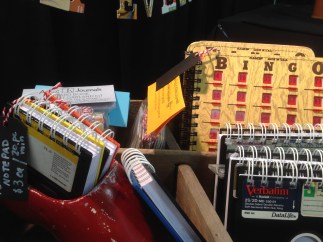
√ Attic Journals uses old book covers, bingo cards, floppy disks and other items as covers for its journals, and incorporates parts of books and old library “book due” cards for its jewelry.
√ People for Urban Progress (PUP) makes “goods for good,” rescuing “discarded materials [and] redesigning them for public benefit” in Indianapolis. They started in 2008 making messenger bags and other items with material salvaged when the RCA Dome was torn down. The bags, in particular, have a great distinctive look and, if you will, vibe. Product sales benefit various projects the non-profit supports as well as local artists, designers, and others involved in creating them.


√ Swell Fellow is a Montreal-based company specializing in high-end ties and bow-ties for men (there are a few selections au feminine), some of which feature Scrabble tiles, keyboard keys, and miniature toy pieces such as cans of paint or a Coke bottle. A few ties have a pocket to accommodate a cell phone as part of the fashion accessory.


This one is only tangentially about recycling (“Give old clothes new life!”):
Patricia Vogel and Dominique Serrano’s Button makes . . . buttons. It was late afternoon and I’m thinking snack — when I see this display that looks like very artsy macarons. Well, they’re buttons, hand made in Chile, and they’re sold individually as brooches and buttons, or in pairs, with magnet backing, to use to tie a scarf or spiff up old clothes.


OK, not as good as a macaron, but refreshing in its own way.
Need a fresh pair of eyes to update your competitive positioning? Contact me here.
Haven’t Had Your Fill Reading About Pokémon GO Yet? Try This…
Following up on why there won’t be a “next” Pokémon GO, as if there hasn’t been enough written about it:
- Book and toy as well as mass merchants and other specialty retailers, are not surprisingly reporting vastly increased demand for Pokémon merchandise. See Publishers Weekly for bookseller (and bookstore café managers’) comments on how the “New Pokemon Game Takes Bookstores By Storm.”
- While there have been reports that Nintendo is signing Pokémon GO licensing deals “left and right” (see NY Post), that is inaccurate on several counts: First, Nintendo doesn’t control the rights, The Pokémon Company (TPC, of which Nintendo is a part owner) does.
 Second, The Pokémon Company signed its deals for the 20th anniversary of the property last year and marked that occasion with a Super Bowl commercial this past January. So while the degree of success of the app was unanticipated, the fact that there would be renewed attention on the property, which Millennials grew up with, was not.
 - The Pokémon Company London office covers all of Europe, where poster and other merchandise licensee GB Eye’s Max Arguile relates to me his own conversation with the company. “Given that there is no difference between the artwork of Pokémon and Pokémon GO,” Arguile says TPC told him, “it makes no sense for them to spend time negotiating licenses that would effectively replicate what they already have in the market (and either making licensees pay twice for the same thing or annoying them by appointing a competitor). The only difference in artwork is the addition of GO to the logo. If [their position on not licensing separate Pokémon GO Images] changes they will let us know but right now they are busy fielding multiple calls every day from all the major retailers — this is where the real money is, not in adding licensees. [In the wake of the Pokémon GO Phenomenon,] Tesco, Asda, Sainsbury, Primark, Debenhams, Matalan and M&S have all ordered big apparel ranges for Q3/Q4 2016. This will be achieved by print-on-demand. Other categories, such as bedding are going into most of the same retailers.” Arguile adds that TPC forecasts “some big collaborations in 2017.”
- The most recent estimate of worldwide retail sales of licensed Pokémon merchandise is for 2014 at $328 million, according to The Licensing Letter. I estimate that in 2015 the property would have been down somewhat as is typical prior to an event such as a 20th anniversary. Published reports of $600 million seem way out of range.
- Publishers Weekly isn’t the only non-game trade magazine reporting on Pokémon. Try this one from Billboard, about the characters landing in music business offices. Not to mention the fact that the New York Police Department issued Pokémon GO Safety Tips, sent by email to subscribers to its various alerts as well as posted on its website.
- While Millennials are the core audience, even among my boomer contemporaries, the topic literally came up in every dinner conversation the past week, and a number of friends have downloaded and played with the app, though they’re not going out in search of merchandise. (At least not until this filters down to their grandchildren…)
Why There Won’t Be A ‘Next’ Pokemon GO
NEW YORK, NY; July 12, 2016—Here’s the Pokemon GO story — “How Pokemon GO Took Over The World And Why There’s No Point In Ripping It Off,” a commentary by The Wrap’s Phil Owen — you need to read if you’re wondering how to cash in on the craze.
 For years I’ve been warning people that building their business plan on being “the next Beatles,” “the next Disney,” “the next Andy Warhol” is to set yourself up for failure. If you do that well, great — and hopefully you can be prepared for how to prolong the life of the property or project. But most business propositions aren’t going to hit the stratosphere.
Years ago I asked Clive Davis, the legendary music business impresario and then Arista label-head, how surprised he was when the single “There Goes Another Love Song” off the Outlaws’ debut album was a hit “out of the box.” “Not surprised enough not to know what to do.”
It was a brilliant answer that I’ve quoted often, and that has informed much of my research into and thinking about pop culture over the years.
I don’t agree 100% with Owen: I suspect there will be a market for other Pokemon GO-like augmented reality games. They just won’t be the phenomena that Pokemon GO is, and as long as the creators don’t scale up for being “the next Pokemon GO” at least some will be viable.
The critical question is how long Pokemon GO can be sustained and, for Nintendo, whether it will have a salutary affect on sales of Nintendo game systems, games and licensed merchandise. (See my recent post, “Sustaining Licensed Properties In A Multi-Platform Universe.”) Generally, the faster a fad takes off, the faster it crashes.
FYI, if you’re a gamer of a certain age thinking it’s time to cash in on your dusty classic Pokemon collection, eBay had 440,296 Pokemon items available when I just checked, 95,548 of them trading card collections.
Need competitive research? Someone to bounce marketing strategy off of? To educate corporate officers about licensing? Contact me at ira@iramayer.com.
 Mayer On Marketing, Licensing, and Merchandising