What I Learned at Licensing Expo 2015, Part I: It’s Time To Retrofit Retro

Call it what you will — retro, vintage, nostalgia, classic, evergreen — the “everything old is new again” refrain has been perennially popular in licensing. But just using old images, or original packaging, is NOT the name of the game:

  • Look at how Nick updated the Teenage Mutant Ninja Turtles and Saban the Power Rangers — and the huge success they’ve enjoyed on air and in consumer products. (I estimate that the Turtles exceeded $1 billion at retail worldwide in 2014, while the Power Rangers continued their upward swing to in excess of $350 million worldwide.)
  • Nintendo’s Mario Bros., Bandai/Namco’s Pac-Man, and other video game companies are stressing pixilated images in their style guides. These are true to their origins but have the added benefit of playing off the popularity of styles popularized via LEGO and Minecraft, as my colleague Karen Raugust points out.
  • “Throwback jerseys” are made of contemporary fabrics. “The Mick’s” throwback comes “equipped with Majestic’s amazing Cool Base technology to keep you cool and dry whenever it heats up!”
  • Archival art, whether Fuller Brush, the Smithsonian Library’s Seed Catalog Collection, or the Saturday Evening Post seek to wed “nostalgia with innovation,” as Fuller Brush says in its promotional literature. As do we all.

More from Licensing Expo in coming days.

Merchandise Wagging The Book At BookExpo

New or recently new exhibitors at BookExpo America, the book publishing tradeshow in New York City this week, are using plush, handbags, and other items to differentiate their books in the competitive children’s and YA aisles. Some is licensed, or (hopefully, from the view of the authors and designers) will be. And some prefer to maintain control. (See my previous post for a report on artists at Surtex and the National Stationery Show similarly wanting to maintain control.)

Much of what we saw this week is being manufactured for show display only, as a test, or in small quantities the authors sell on their own websites.

Louisiana-based author Lance Olsen and illustrator Thomas Perry were showcasing their “Sharky Marky” preschool book with a plush shark in a plush car, both of which they fabricated for the show. The website also features coloring book sheets that can be downloaded. They had a sign that they’re looking for a literary agent and/or publisher, and they’re amenable to licensing. Distribution is primarily via Barnes & Noble and amazon, plus a handful of stores in Louisiana.

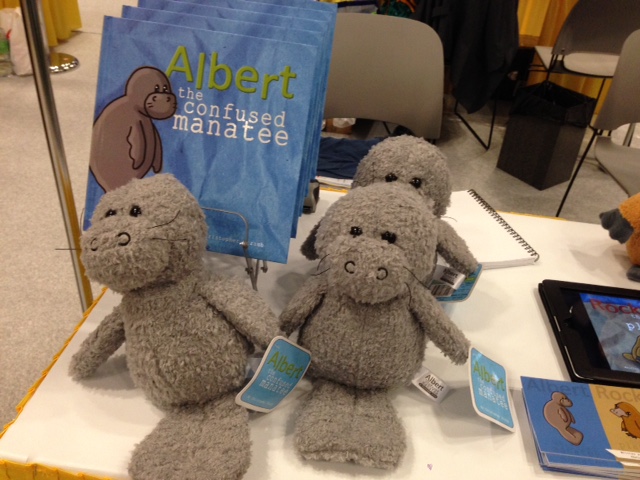
Author/illustrator/designer Christopher Straub had similarly beautiful 9” plush for his books, “Albert the Confused Manatee” and “Rocky the Confused Platypus.” Indeed, the level of detail in the plush was striking, making the book characters seem a little plain by comparison.

Straub told me he had to have the fabric for the platypus made to his specifications because he couldn’t find something the right color that had as good a feel as the fabric for the manatee, and he is concerned about continuity in the look and feel of the characters.

Straub sells his books ($17.99 MSRP) and the plush ($22.00 MSRP) on his website, and estimates he’s shipped about 2500 books from his home office over the last six months.

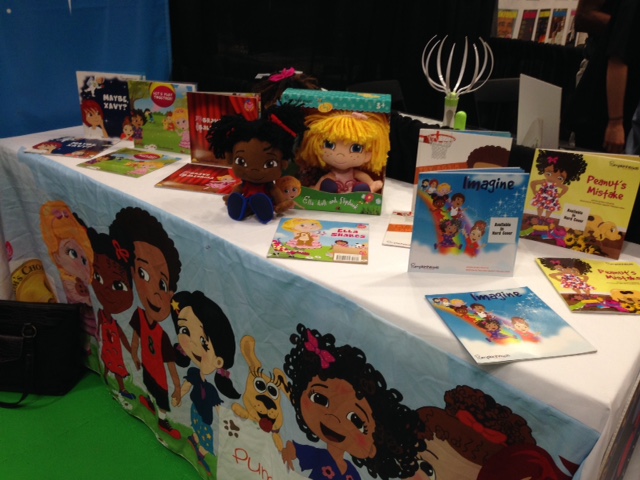
PumpkinkidsAuthor/illustrator Karen Kilpatrick, based in Florida, is working with licensing business pro Joan Packard Luks to build on her series of learning books based on her Pumpkinheads characters. The books are self-published for the moment, with Baker & Taylor and other traditional distributors making them available as well. An app has just launched, and Luks says animation is in the works, as well as formally licensed merchandise.

BeautyLand Couture is an online retailer offering beauty items from hair appliances to HBA to candy sticks, as well as handbags and apparel for young teens.

Madison KThe book tie-in? A YA series built around a character named Madison K., an 18-year-old fashionista with positive morals and work ethic created by author and BeautyLand Couture founder Nina Kaplan. A third book in the Madison K. series launched at the show, as did some new Kaplan-designed merchandise.

Of course there were plenty of licensing business standbys at the show:

Disney Publishing had a relatively modest booth.

Candlewick Press is using the inside of the dust jackets to create coloring posters for Peppa Pig and other titles, and is doing book + novelty packs for Peppa, including “Love Game” for the upcoming Valentine’s Day. (Candlewick shares U.S. book rights for Peppa Pig with Scholastic — different formats for each.)

Bendon and Parragon had their wide assortments of licensed titles.

Plenty of Star Wars and Star Trek, as well.

And there were a handful of very creative book-based companies that sell their own very unique merchandise. Two standouts:

  • I continue to be impressed by Litographs, which designs shirts, prints, and other goods in designs composed of all the words in the book in teeny tiny type.
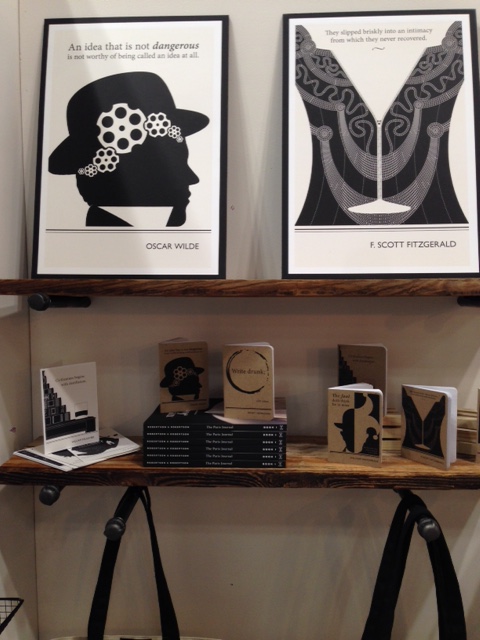
  • Obvious State BEANew to the show this year (but in business for two years), is Obvious State, which creates art out of quotes, titles, and other book-based sources.

Both companies handle their own manufacturing, but their designs are certainly licensable for categories beyond those they make or source themselves.

Contacts:

Nina Kaplan, mkblcbeauty@gmail.com; 267-644-6119

Karen Kilpatrick, Karen@pumpkinheads.com; 954-309-3640

Joan Packard Luks, joan@serenatagroup.com; 201-224-2190

Lance Olsen, olsenimages@gmail.com; 504-919-0082

Christopher Straub, info@christopherstraub.com; 612-387-4488

Art & Design Trends: Brooklyn, Sustainability, Letter Press, and Licensing (Sometimes)

Brooklyn has been coming on strong at Surtex, the trade show for licensing and selling original art, for several years. This year, it seemed as though every third booth at the mid-May show and at the co-located National Stationery Show (NSS), had a sign up proclaiming a Brooklyn provenance.

Granted, Surtex and NSS take place in New York City; Brooklyn is part of New York City, even if most people think NYC synonymous with Manhattan (full disclosure: I live in Brooklyn). And Williamsburg, a hip neighborhood in Brooklyn, is home to many artists, their studios and galleries.

Add relatively cheap rents in nearby Industry City (still in Brooklyn). This is a cluster of large former industrial buildings with high ceilings, huge windows looking out on New York harbor (or the Gowanus Expressway on the even cheaper side), and heavy-duty floors. Here the streets are home to a host of adult video stores, a large cheap green grocer, Costco, and a MicroWarehouse. Artists, letter presses, and even some small manufacturers are inhabiting that group of buildings, which are being rehabilitated—and exhibiting at Surtex and NSS, which can feel like a local show until you note the letter presses and other exhibitors from Baton Rouge, LA; Minneapolis, MN; Worthington, OH, and elsewhere. Far elsewhere.

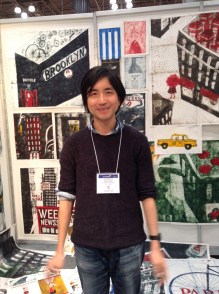
Indeed, Brooklyn appears to be a mindset as much as a physical location. Looking at his work, I asked Mitsushige Nishiwaki, pictured here at Surtex, where he lived in Brooklyn. He laughed. “I live in Tokyo. I thought if I exhibit in New York, I need to have New York art.”  IMG_0150His work is based on pictures he finds in magazines. He has several pieces about specialty donuts. “There’s a famous shop in Williamsburg,” he told me. “I add a little humor to the pictures.” His company is Etching Art Design; click here  for his designs from Paris, London, Italy, and elsewhere. He’s had gallery shows in various cities including New York, and has a clothing licensee in France for a 2016 collection; I suspect there will be others.
Holstee, a Stationery Show exhibitor, brings together a variety of trends in the art/artisanal sector: Based in Brooklyn; designing products with sustainability as a guiding principle; providing fair wage employment in third world locations. Prime example: The company’s Upcycled Wallet is “vegan” product (I admit I don’t know what that means other than that it’s not leather) that “provides the impoverished with fair wage employment while simultaneously reducing waste in Delhi.” Holstee’s City Leaf Map posters seem like a licensable design.

One of the ironies of these two shows being co-located is that many of those at the Stationery Show, including Holstee, really are designers making or sourcing their own products and selling directly to retail or on their websites. Many could be licensing their designs over in the Surtex aisles, a notion which interests some but not others.

For example, Graphic designer Cayla Ferari and engineer John Breznicky’s company LinePosters makes posters, glasses, t-shirts, and stationery based on Ferari’s line drawings of mass transit maps. They started selling wall decals based on a line version of the NYC subway map in 2011. They’ve added other cities, and some generic transportation-themed designs such as spoked bicycle wheels. Ferari says they like the control of making their own goods, including laser cutting coasters and doing their own printing. They have some specialty retail distribution and “for best selection” suggest their website.
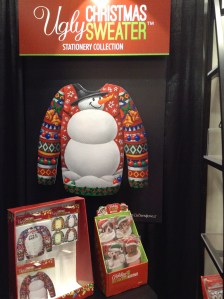
IMG_0147Other exhibitors are more opportunistic. CrownJewlz, which offers a range of notepads, die-cut stickies, and other stationery items by a variety of more traditional artists, obtained a trademark for UglySweaters paper and stationery products (see photo at right). I’d expect to see a host of beyond-sweaters products this year, given the success of ugly sweaters last holiday season. Why not stationery?

I’m surprised that Disney, Nick, Peanuts, and others with entertainment/character properties haven’t licensed the Pop-up Snow Globe Greetings cards made by Up With Paper (download the 2015 Everyday catalog to see examples, though this doesn’t do them justice; the effect is quite good). Or maybe they have in the past and I just haven’t seen it — the product has been around since 2005. It’s paper with a clear plastic globe that comes collapsed in an envelope. Monika Brandrup-Thomas is VP/Creative Director, based in Guilford, CT.

Finally among the exhibitors that caught my eye: Berlin’s L.M. Kartenvertrieb & Verlags GmbH uses original designs by Juan Carlos Espejo to evoke images of Marilyn Monroe, Charlie Chaplin, Audrey Hepburn, Andy Warhol, and others for 3D bookmarks, rulers, door hangers, luggage tags, and other products.

With Adidas Out At The NBA, Who’s Next?

For my (and others’) comments on how this might play out, see Hiroko Tabuchi and Ken Belson’s story in The New York Times. What’s your take?

Unintended Potential, Part I: Talking Barbie

There’s a lot of talk about STEM (science, technology, engineering, math) and STEAM (add “arts”), and plenty of laudable products to support entertaining educational play. Mattel supports Nickelodeon’s BLAZE, for example, and there are a wide array of licensed Discovery toys spanning an array of subjects.

But sometimes there seem to be hidden potential applications for other toys. Take Mattel’s new talking Barbie. A child can ask questions of the doll; questions and responses are stored in the cloud, content can be updated by Mattel, and the doll builds on past conversations.

We asked whether there had been any thought to a wider range of inquiries and whether the doll searches the Internet. “Barbie will never search the Internet; we’re COPPA [Children’s Online Privacy Protection Act] compliant,” came the reflexive response to an anticipated question that might have insinuated Barbie entertaining inappropriate subject matter with her charges.

But I was asking in a different context. Last fall there was a media frenzy when a mother wrote an article for The New York Times about how Apple’s Siri app engages her autistic son by being willing to pursue a subject endlessly. (See also NPR interview with the mom.)

The Mattel spokespeople were intrigued and introduced me to the outside developer who had created the Barbie application, Benjamin Morse, “Teddy Roboticist” for Toy Talk, a San Francisco company that has previously developed the apps The Winston Show (“a talk show where the characters talk back”) and SpeakaZoo (“where you talk with the animals”).

Feels like there’s something there for someone, whether it’s Barbie or otherwise.

Unintended Potential, Part II: Anki Racing Set

This seems like a slam dunk licensing opportunity that the company isn’t even thinking about. Anki has a physical car racing game that is controlled by an app. But this doesn’t use the touch screen so much (at least not for steering) as the motion of iPhone or iPad which is used like a steering wheel. Speed is controlled by moving your thumb on the touch screen.

The app was highlighted by Apple two years ago, just about the time other toy manufacturers were trying apps where you ran the toy vehicle over the actual screen (a scary scenario for most parents).

In a reverse out of the usual set up, where you download the free app and then have in-app purchases to enhance the playing experience, with Anki you buy the physical tracks (a lightweight flexible plastic), special toy cars, and then download the free app to run the whole thing.

So far I’m told there isn’t a plan to license – the company is focusing on distribution of its own Anki Drive sets (about $150), but it’s easy to envision the Thomas version, the NASCAR set, the Batman set.

Must Read: Karen Raugust On the ‘Maker Movement’

The “Maker Movement – a hybrid of engineering and invention on the one hand and arts and crafts on the other” has surfaced in the toy arena. See Karen’s blog post here.

Licensing Is Here To Save The Day

LEGO once derided licensing, saying it would never move away from its core generic, unadulterated building set business. But new thinking was needed amid hard times not so many years ago, and the Star Wars license turned the company around.

Star Wars was truly just the beginning of LEGO’s licensing, and it is licensing that has made the company one of the top global toy manufacturers. Recently, I asked a cousin’s 8-year-old daughter which LEGO sets she has. (I’d been tipped off that she was heavy into Star Wars.) “I’d rather tell you which ones I’d like to get,” she replied, and proceeded to rattle off 19 sets – all of them Harry Potter – before scrunching her nose. “There are 21 I want. Which two am I forgetting?”

Certainly Angry Birds did a lot for Commonwealth Toys a few years ago. And now it will be interesting to see how Germany’s Schleich will fare. Schleich’s core business is upmarket plastic figurines of prehistoric animals, generic knights, wild life, and farm life. They tend to be sold in specialty toy stores.

Years ago, the company licensed Smurfs, and its success led Schleich to license extensively. The company had severe financial difficulties and swore off licensing, except for continuing its Smurfs relationship. It tried developing its own fantasy property, Bayala, that it hoped to license out into other categories (the property still exists, but I’m not sure much ever got licensed). And now the company’s Toy Fair presence was dominated by its new DC Comics (specifically Justice League) and Peanuts licenses. The people at the booth, who are from Schleich’s North Carolina-based U.S. distribution operation, weren’t familiar with the company history but, noted Soren Philip Hjorth, who is president of Schleich USA, “This isn’t that company.”

When Is A Dinosaur Not A Dinosaur?

Licensed products weren’t an easy sell to the consumer on the original Jurassic Park movie. “A dinosaur is a dinosaur” is what people said at the time, or as one licensee of the upcoming sequel, Jurassic World (this June), puts it, “Dinosaurs are universal.” (No pun intended relative to the film’s distributor, Universal Studios.) This one’s also not so lovable and cuddly, at least based on the trailer. That’s usually not a positive indicator for licensing but can mean boffo at the box office, as Variety used to say.

Does Marvel Play Nicely With Others?

Will Marvel step up its co-branding? Allow more flexible use of its characters? They already co-brand with Mattel’s Matchbox; will they do the same with Hasbro’s Transformers?

You could argue that Transformers are already their own characters with their own personalities (so to speak). But Hasbro’s Super Hero Mashers line lets kids take Transformers, Marvel, Jurassic World, Star Wars, and other figurines apart to mix and match body parts, outfits, and weapons.

Will other studios allow similar use? Kids always took their toys apart anyway – in this case, is Hasbro just facilitating a play pattern that hasn’t been officially recognized before?