Licensing Expo At 35,000 Feet: Sustaining Licensed Properties In A Multi-Platform Universe
EN ROUTE, LAS VEGAS, NV to NEW YORK, NY; June 23, 2016—Over 26 years attending Licensing Expo, whether sitting down to interview people or walking the aisles, I always get variations of the same question (especially from exhibitors who rarely get to leave their booths): “What are you seeing on the floor?” “What’s new?” “What’s hot?”
The truth is, when you’re at the show, the elaborate exhibits, the characters walking around, the noise, the constant visual bombardment make it difficult to process what you’re experiencing beyond realizing that the longest line at the show was to have your picture taken with Grumpy Cat (except for those of us allergic).
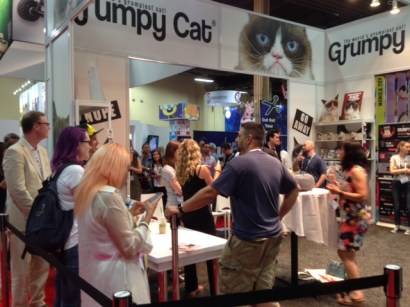
Smiling with Grumpy
So to all who asked me that question this year, while I was in my tradeshow stupor, and to those just wondering, 35,000 feet on the way home offers the needed distance to pull some thoughts together.
The key theme for me: Sustainability has dual meanings. One is environmental, which is subject for another time. The other is about sustaining the life of a property in a digital age. I’m going to focus on the entertainment/character/gaming worlds here, but that subject is top of mind for every brand, fashion, sports, art, and other licensor, manufacturer, agent, and other player as well.
Traditional media still count, certainly to companies rooted in it, but the fact is many of the digital content producers don’t yet understand the importance of multiple platforms, including the traditional ones.
“Linear still has the reach and consistency you need” to support a licensing program, Cartoon Network’s Pete Yoder told me. “But we also know mom hands off [he moves his smart phone from one hand to the other] to the kids.” Three key changes in the digital age:
- “We’re developing content specific to each digital medium. It’s based on the same IP but we’re not just re-editing 11-minute programs to 90-seconds.”
- “We’re ordering the number of episodes we need by medium from the beginning.”
- “Years ago you needed 6 months to a year after a program was a hit to get a licensing program underway. Now the question is, ‘When are you launching the first access to the brand’” via any medium.
At Activision, the “traditional” medium is games, and that — just as obviously as TV is for Cartoon Network — continues to be the core. But the news at Activision is a Netflix commitment to two seasons of a Skylanders Academy series. “Our audience is 6-12, with a real sweet spot of 6-9,” the company’s Ashley Maidy noted. A linear program, for her, has the potential to “bring new kids in — younger kids whose older siblings know the game, as well as others who just haven’t been exposed to it at all. . . .It’s a marriage of digital product and multiple platforms.”
The transformation of Skylander across platforms has proven easier than for Call of Duty, but a film is in the works for that, as well.
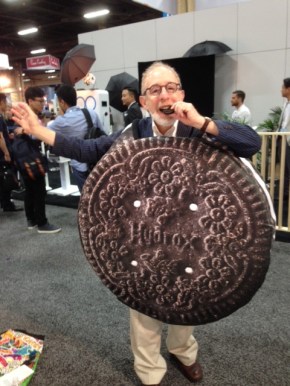
Your humble correspondent stopping for a little food for thought.
Activision’s challenges — and a common refrain at many companies: “We still have to educate buyers and retailers who are tradition-bound that our customers aren’t watching TV. And with no ratings for Netflix, how do you measure success?” [Aside: One of the most promising areas to Activision founder Bobby Kotick, Maidy says, is eSports, which Kotick believes — and Activision will be playing an ever-greater role to accomplish — could be as big as the NFL in five years. Why not think big?]
Both Yoder and Maidy agreed with me that even two years ago if someone had offered them Netflix as an outlet for a series they would have turned up their noses. Not anymore.
That said, hyperbole from the digital world doesn’t really help on the measurement count, in part because it feels as though (not just at Licensing Expo, but in the “wider world”) that the digirati don’t really understand what’s important to know. They can measure all sorts of things, but those numbers don’t necessarily translate to something the IP, ad, or licensing worlds can use.
Consider Paladin Software’s James Creach, speaking as part of the Digital Licensing Summit program at the Expo, who observed that “the Super Bowl is watched by 112 million people but 1 billion people are active on social media in a month.” Well, an event watched simultaneously by 112 million people — roughly one in three Americans — is a very different story than a billion people spread across almost as many messages of all sorts. The latter isn’t unimportant, but the comparison does no favors in selling the medium.
I didn’t get to speak with anyone from Youtube, but their booth looked like a lost opportunity. Clearly a major player as an outlet for new IP as well as for creating new channels for existing programming, the company had a huge space. But from the outside all one saw was a small sign with some of the properties named. No effort to educate what the properties are, where Youtube fits in, how it translates into consumer products or even just to pique interest. I don’t think I’m alone among show attendees (OK, of a certain age — but younger as well) in having heard of only a very few of the properties named.
I’ll get off my soapbox in a moment. But coming from the print publishing world, one of the things I’ve watch many “digital-only” publishers discover is that at this point in time, to satisfy advertisers, they still need print. Similarly, digital video celebrities or others will find it difficult to sustain their fame or develop long-term careers without multiple platforms — and I don’t mean just multiple social media. Just as traditional media have been forced to embrace new media, so new media will need to embrace the old. Tyler Oakley, who is part of the Dreamworks/Awesomeness stable, gets it: he’s out there touring with a live show, there’s a documentary, AND he keeps up his video and social media output. Rock and roll, watch out. [Commented one music merchandiser: “We survived superheroes and Star Wars. Music is trending up.”]
Most trenchant observation by a newcomer to licensing at the show, though: John Haugh, the 3-months new CEO and President of Iconix, at a reception for Peanuts licensees: “I know many of you would like a Peanuts movie every year. We would too, but nobody does a movie every year, not even Star Wars. And I want to remind you that many of you have done very well with Peanuts for 50 years before there ever was a movie!” Talk about sustainability!
What Won’t Be Obvious Walking the Floor at Licensing Expo
NEW YORK, NY: June 15, 2016—Here are some of the questions I’ll be thinking about as I walk Licensing Expo in Las Vegas next week:
- How will Disney replace the incredible revenue stream that Star Wars, Marvel, and Frozen merchandise have generated in the past three years? (Notes: If historic trends hold, the second Star Wars film in the current series is not likely to generate the same merchandise sales as the first. As for Marvel, superheroes are cycling out in a natural pattern. It will be another generation before that genre is ripe for the next go-round. Superheroes won’t disappear, but they won’t have the same impact on merchandise sales for a while.)
- Which new digital celebrities or other properties will still be popular when their licensing programs hit retail?
- Which ones that were hits last year are having an impact now?
- What are the success factors for digital properties vs. those that emerge from traditional media? Toys? Brands? Art? Sports? Fashion?
- Will more niche properties get a foothold, thanks to the fragmented media and retail environments? Or is “the long tail” a mirage?
- Does the celebrity-based capsule collection trend have legs? (I expect to see more and more of these. Good differentiators for retail, and good testing ground for broader programs.)
- Which agencies will raise the capital to acquire brands (or stakes in brands) of their own, reversing the business model of Iconix, Authentic, Sequential and the not-so-little engine that does…PVH?
- What would brand ownership do to the agency business model, which is already under pressure to add services outside their core expertise, not to mention to compete for consulting revenue by representing manufacturers?
- Speaking of Iconix/Authentic/Sequential: Is that business model viable long-term (again, works for PVH, which has been at it for years)? Where are the fault lines, doubters?
And my questions for you:
Need competitive research for your licensing program? Looking to benchmark against comparable brands, products, or properties? Seeking valuations for banks or legal proceedings? I can help. Email me at ira@iramayer.com and we can set a time to meet Monday (the day before Licensing Expo), Tuesday or Wednesday morning in Vegas.
Need to educate new employees or upper management about licensing? I’m teaming with licensing consultant Karen Raugust to offer executive briefings and training workshops for corporations and other organizations involved in licensing. Content is customized to suit your needs. Visit www.iramayer.com/education for details, or contact me as above to set up a meeting at the show (or after).
Want to know how to work with licensing agents and consultants? Attend the LIMA-sponsored Licensing University session I’m moderating with Gary Caplan (Gary Caplan, Inc.), Carole Postal (CopCorp and Knockout Licensing), and Ilana Wilensky (Jewel Branding & Licensing). The session is Tuesday, June 21, 11:15 a.m. – 12:30 p.m. in Tradewinds F at the Mandalay Convention Center. (Registration required.)
Or just be in touch so we can say hello, clink waters in the hall, and you can let me know what your questions are!
Have a great show — and watch this space for my reports from the floor.
 Mayer On Marketing, Licensing, and Merchandising