Walking Toy Fair 2016: Trends, Start-ups, and Licensing Opportunities
NEW YORK, NY: FEBRUARY 16, 2016—My favorite parts of Toy Fair are invariably the far aisles on the main floor upstairs and the downstairs exhibits. That’s where many of the start-ups and smaller players are and where you get a sense of the ideas that are propelling toy inventors and designers.
Here are my idiosyncratic impressions after two days walking the show at the Javits Center, with a few added comments based on a recent spate of store visits.
Star Wars isn’t disappearing any time soon. Sphero will have competition for its BB-8 later this year when Spin Master brings out its own version of the robot. The creator of the Spin Master BB-8, Thomas Tretter, was doing the product demos, happily admitting he “gets paid to do what he did as a kid.” Also via Spin Master, Air Hogs will have an expanded Star Wars line.
But SW was ubiquitous, if anything moreso than even last year and eclipsing even the strongest of the strong. Manufacturers uniformly report that Star Wars is still going gangbusters, and many are still developing new assortments. Marvel is Marvel, DC is DC, and they’re next in line. I was surprised not to see more new Minions on the boards, as retail is still going strong with that as well.  Universal’s Secret Life of Pets clearly has momentum, though, with Spin Master’s Best Friend Max wobbly-walking dog from that upcoming film a candidate for next Christmas’s must-have toy (Elmo beware). Commonwealth and Spin Master are also working Angry Birds in anticipation of that film.
The expansion of Melissa & Doug, once exclusive to specialty toy retail, is nothing short of astounding. The company used to eschew licensing, but has some Disney and other properties. However, unlike LEGO, which reinvented itself (and came back from the walking dead) through licensing, Melissa & Doug hews true to its origins even if distribution has expanded to mass, education stores, and more.
JoyLabz had perhaps the oddest display among the robotics/electronics startups: Makey Makey was demonstrated using a piece of tin foil folded on a table, with hand-written marker instructions, and five bananas with connector leads in them hooked up to a laptop.  Touch the foil with one hand and use the other hand to hit the bananas (“it could be anything conductive; we just used bananas,” the demonstrator noted, though their sales materials feature bananas too), and you get music from the laptop. The kit can also be used to make game controllers, instruments, and “inventions.”
There’s really no breakout company in robotics. If I were a buyer, I’d be hard pressed to decide who to go with — both whether they have the wherewithal to deliver, and what might make the product stand out. Most seem to create different lighting or noise patterns from generic component parts, and there’s little guidance for what you can do further. As a group, they’re coming of age, but they’re not there yet.
Among the more traditional science kits, Smart Lab used licensed Star Wars and Disney Princess to distinguish itself. Based on retail visits as well as the show, Smithsonian and National Geographic are dominating this sector at specialty, in book stores, and at mass.
3Doodler and Creopop are among several companies offering handheld 3D printer pens. 3Doodler has had an adult version on the market at $99; the new child version is $49. Different colors of instant-hardening plastic are available. Using the pens requires pretty serious fine motor skills; not clear to me exactly who the market will be for kids versions. 3D printers are also rapidly coming down in price to where they might have potential as consumer items, but again, the killer app that could transform them from “having potential” to “must have” has yet to surface.
A year or two ago formable sand products for home and school were relatively high end, sold by Brookstone initially; the variety is expanding rapidly now under a variety of names (Kinetic Sand from Spin Master, but Magic Sand, Aqua Sand) — in colors (including glow-in-the-dark from Sands Alive), packaging, and price.


Zing’s StikBot Studio — a toy-size green screen with little characters you can use to create your own stop motion animated videos — expanded its one-year-old line with a more extensive “Pro” kit. Zing also has Wet Head, which is a hat with a little reservoir for water and stick plugs coming out. It’s essentially “Russian roulette with water,” as a demonstrator put it — the hat is filled with water, players spin a wheel to indicate which plug to pull out, and eventually one of the pulled plugs releases the water.
AzIAm Girlz yoga dolls, which first shipped this past December, is growing its line.
There’s growing availability of sophisticated tool sets. New at the show this year was Toydriver from the “smart screw specialists.” Toydriver is a mini powered screw driver designed for the small screws used in children’s toys but also for small hands. Sidenote: Toys R Us carries an extensive line of Home Depot-branded tools and child-sized workbenches and the like that are truly standout.
On the gardening front, Triumph Plant has been doing a beautiful job with Crayola for a number of years.  There’s a My First Plant series, and a Color A Plant Pot kit. And they’re re-introducing a Charlie Brown tree to go with their Charlie Brown Grow a Pumpkin kit; the tree had been around for a few years, but the company wasn’t able to get the seeds for the last two years. Triumph’s Jim Johansen also said the company has licensed the Garden State Parkway for a wildflowers line. It’s an outgrowth of Lady Bird Johnson’s highway beautification program and could be expanded to cover other states’ highway wildflower programs.
Morphmallow’s Spaghetti Headz hair accessories remind me of the coiled shoe laces that were a fad for a couple of years. Generic versions of Spaghetti Headz have been on the market at $9.99 list for about two years;  Morphmallow, exhibiting at Toy Fair for the first time, is now adding licenses including Care Bears, Garfield, Betty Boop, and the upcoming Steven Spielberg film The BFG selling at $12.49. Target is tweens to young teens, with the designs with feathers at the end appealing to the older end of the spectrum.
Capson and Zoofy, to name just two, are outfitting caps (brand name Brick Brick) and backpacks, respectively, with boards that work with Lego and other similarly sized building blocks as well as with miniature versions so kids can customize their look.  Capson had the Disney logo, an As logo, and a Hello Kitty image to show what you can do, but was quick to say they don’t license those images, “they’re just to demonstrate what someone can do.” In fact, they don’t even sell blocks — those are user-supplied. Zoofy used generic designs to illustrate the potential on its backpacks.
Pinbox 3000 is likely typical of many toy startups these days: They used a Kickstarter campaign to raise the $15,000 they needed to make the diecuts they needed for the first run of their cardboard “pinball machines” which are blanks.  The examples they showed demonstrate how you can draw or photograph your own backgrounds, use discarded toys or household objects, and so forth to create your own game. Make, an online magazine (makezine.com) wrote about the product last July and started selling it. That sent them back for a second run. They’ve also developed special education and library market versions. The basic kit is $49.95; a large “double kit” is $89.95.
Speaking of make your own: Yottoy, which is both a publisher and makes plush and collectibles with licenses for Babar, Madeline, and others, signed on as an Eloise licensee about a week before Toy Fair. A beautiful lunch kit was hand painted to get it on display in time, VP creative director Peter Doodeheefver showed me proudly. Sales of licensed Madeline merchandise benefited enormously from a museum exhibit at the New York Historical Society, as did sales of Paddington goods with release of the Paddington Bear movie. Next up for them is The Little Prince movie; but Yottoy typically has these properties long-term; the movie and museum shows are bonus opportunities.


Not a toy per se, but a fun product: Fan Hands (company and product name) — special gloves designed to make a loud clap when at a sports event. Marc Jones, President/CEO and inventor of the gloves, has had the patent since 2013 and has been selling a generic version. But if this isn’t a product designed for licensing… Jones has a relationship with CLC for another product line he developed; he’s looking to expand that to Fan Hands, and to add MLB and NHL “to start.” NFL, he says, is too complex and too expensive to deal with starting out.
Colorforms and Highlights are two children’s brands that have been largely dormant for a number of years. Both are re-establishing their reach through licensing programs the results of which were in evidence at Toy Fair this year and should be more in evidence at retail over the next 12 months. Colorforms is owned by Out of the Blue; Highlights is independently owned.
 The success of eOne’s Peppa Pig — which itself is expanding its licensee roster through U.S. master licensee JazWares — is prompting a small surge in other pig properties. Not that pigs haven’t always been popular, but this year sees the addition of Pass the Pigs dice from Winning Moves, among others. Note to Warner Bros.: Is it time for a Porky comeback?
That’s all folks!
Ira Mayer, former publisher and executive editor of The Licensing Letter, conducts competitive research and consults for marketers; takes clients on retail tours; and offers courses on licensing through colleges and universities. You can contact him by clicking on the “Contact” button above left.
Walking NY NOW: Licensing Opportunities, Updates and (By Gum) Fun!
NEW YORK: FEBRUARY 3, 2016 — From the floor of NY NOW, the Emerald Expositions tradeshow for “home, lifestyle and gift” products:
Opportunistic Vote. FCTRY has been selling its Hillary Clinton action figures for about a year. “After Iowa, we’re rushing Bernie [Sanders] into production.” 
Reviving a Regional Brand. Louis Sherry. Boomer New Yorkers know the name from fine chocolates and ice cream, and its eponymous owner’s posthumous role as one half of the Sherry-Netherland Hotel name. “The brand never totally disappeared,” Louis Sherry, Inc. President Tim Tippin told me. Tippin was standing behind an array of tins sporting the original colors, designs, and logos from Louis Sherry confectionary. Beatrice Foods was the last “major” owner (Beatrice and its assets went through multiple hands after KKR bought them in the late 1980s). Tippin acquired the brand about nine years ago and, together with his fiancé, whose grandfather was involved with the original company, oversees the operation producing hand-made chocolates. 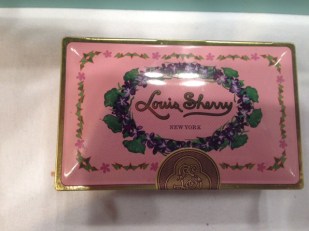 “It takes a long time to research the original packaging and come up with the right products,” but he’s been selling the chocolates in recent years to upscale resorts and department stores including Saks and Henri Bendel. “I’m open to a ‘better’ coffee or tea licensee, and a premium ice cream licensee,” he says. Ironic note: Back in the early 1960s, Tippin adds, “Louis Sherry distributed Haagen Dazs when it was just starting out.”
From Sourcing to Licensing. Cufflinks Inc. has been around since 1999, which is about when we first met Marc Ostrofsky, a venture capital investor in Cufflinks and Blinds.com, and author of “Get Rich Click!: The Ultimate Guide to Making Money Online.” He was walking Licensing Expo at the time and wasn’t sure about licensing as a business model for the company vs. sourcing others’ goods for sale via his then-new online-only venture. Fast forward to 2006 and Cufflinks started manufacturing its own products. Today, the company licenses NFL, MLB, NHL, and NBA teams; Marvel; Disney; DC; and, of course, Star Wars, and sells on its website but also through traditional retail channels. “We put aggressive projections on Star Wars last January [2015],” President Paul Song told me. “But we sold out of many Star Wars SKUs in December, and it’s still going strong.” Substantially stronger than any other property, Song notes. Cufflinks also offers licensed socks and ties, and has its own Ox & Bull brand and original designs at Nordstrom, Neiman Marcus, and others.


Doodle Me This. Three year old Eat Sleep Doodle out of Salisbury, England, typically frames the area where you doodle on its sheets, aprons, soft sack back packs and other items with special washable markers. Founder/CEO Chrissie Probert-Jones is open to the notion of licensed images (most likely entertainment properties, or publishing classics) that could be permanently outlined and then colored. Given the adult coloring craze, the time might be right for adults as well as kids.
Pedaling Line Extensions. I recognized Vital Industries’ screen printed (by hand) bicycle glasses from the Brooklyn Museum shop. Late last year Vital added porcelain plates made in Poland to the line, which also includes clothing and accessories. Some of the designs (there are more than bicycles, but that seems to be their signature) are ripe for licensing — those bicycle-design plates would be well suited for picnic gear, paper plates, cups, and napkins.
Under Cover. The Gussy is a printed rain cover for women’s purses. Founder/President Jamie Hantman is open to using licensed designs and to private label. The covers sell for $10 wholesale, $20 retail.
Ira Mayer, former publisher and executive editor of The Licensing Letter, conducts competitive research and consults for companies in the licensing business; you can contact him by clicking on the “Contact” button above left.
Coke Tastes The Licensing Feeling
NEW YORK; JANUARY 27, 2016 — Coca-Cola’s new “Taste the Feeling” ad campaign “will be focused more on the functional and emotional benefits of Coke the product” rather than the loftier brand equity-rooted celebration of the brand’s “role as a social facilitator and symbol of peace, love, friendship and brotherhood” of the prior “Open Happiness” campaign.
That’s Stuart Elliott’s take in his MediaVillage column this morning. Elliott wrote The New York Times advertising column for 23 years, and has been contributing to Jack Myers’ MediaVillage for just under a year (and it’s great to have his voice back!).

One of my favorite licensed Coke products, from Coolgear.
From a licensing perspective, the question is how that new theme will manifest itself in merchandise, and while not mentioning licensing per se, Elliott indirectly addresses the key to a sound licensing program as well as a good ad campaign: emotional resonance.
Elliott wonders “if ads that play up what’s inside the bottle will overlook the specialness of the bottle and the other unique qualities and attributes of Coca-Cola that have contributed to its status as perhaps the world’s best-known (and most-liked) brand. . . . A thirst quencher, yes, but also an intrinsic element of American popular culture and a symbol of American life.”
Licensed Coke products reflect that, and Elliott couldn’t do better than singling out, as he does, the shape of the bottle, vintage ads, the Coca-Cola Santa, and other advertising slogans, as well as songs and movies where Coke has played a starring role. Not to mention the polar bears.
As I told the students in my Branding & Licensing class at LIU Post this week (part of a Branding & Licensing minor inaugurated by the university with LIMA and Beanstalk’s Michael Stone last semester), Coke’s is a classic case study in how licensing can support a core brand. Relative to revenue, licensing is a rounding error at Coke, albeit a highly profitable one. With licensing under the guidance of Kate Dwyer in Atlanta for almost seven years now, Coke tastes that feeling just fine.
Ira Mayer, former publisher and executive editor of The Licensing Letter, conducts competitive research and consults for companies in the licensing business; you can contact him by clicking on the “Contact” button above left.
Why Does It Always Come As A Surprise That Entertainment Is A Hits-Driven Business?
NEW YORK, NY; JANUARY 19, 2016 — “Stars” — and by extension, hits — “can’t do it alone anymore,” concludes Concurrent Media’s Paul Sweeting in a dead-on analysis of 2015 movie box office and music sales. And his argument could easily extend to books, video games, TV shows, and other entertainment media.
It’s hardly news that fewer than 4% of movies released last year would have accounted for 23% of all tickets sold, or that Taylor Swift and Adele dominated the declining CD market (in part by withholding their new music from streaming services). In the publishing world, 21 adult coloring books accounted for 13.5% of total positions on the trade paper bestseller lists last year, according to Publishers Weekly.
In any given week, check out the Monday morning reports to see how much the prior week’s No. 1 movie, album, book, etc. outdistanced the No. 2. It’s pretty dramatic — unless you happen upon a week that’s setting a new record for lowest sales of a No. 1. (Bottom fishing is a contest no one is proud of winning, but it’s happening with increasing frequency.)
None of this is a new phenomenon, though the annual headlines as the full-year data rolls out never seem to recognize that fact. Consider this year’s Wall Street Journal headline earlier this month: “Hollywood’s Banner Year at the Box Office Masks a Procession of Flops.” Was there ever a year when that wasn’t the case? And not just for movies. The thrust is no different than that for the headlines we would have run in the trade magazine Record World when I worked there in the mid-1970s (think Carole King’s “Tapestry” or Fleetwood Mac’s “Rumours”) or that you’ll find in any of today’s movie, music, TV, game, or other trades.
Those headlines reflect the fact that entertainment is a hit-driven business. The “long tail” of the Internet was supposed to change that, because everything (or nearly everything) could be available forever and because fans would find their way to offerings beyond what the studios, music labels, mainstream publishers and others released.
But nothing suggests that the mass audience cares about the long tail. It’s the hits that dominate Youtube and Spotify and Kindle and all of their relations, just as they dominate the box office, and just as they once dominated the now-dying packaged media businesses of LPs, CDs, DVDs, video games, and more. (Important exception: Printed books are regaining momentum from ebooks.)
This isn’t necessarily a bleak scenario. But building a more resilient entertainment business, says Sweeting, “requires a lot more data than most studios or record labels currently collect or effectively analyze, and the sort of data-driven, audience-focused marketing and release planning that runs counter to the hits-driven, star-making machinery the movie and music businesses have long-relied on to drive the business.”
I agree to a point. However, it’s also true that too much of what is produced and released by mainstream entertainment companies has been corporatized to a point of little distinction. It’s interesting that Don Henley’s statement following the death of Eagles bandmate Glenn Frey earlier this week said, “We were two young men who made the pilgrimage to Los Angeles with the same dream: to make our mark in the music industry.” I suspect he was using today’s terminology, because I doubt in the 1970s they wanted to make their mark on the industry. They more likely wanted to make music —and a living doing so.
The bottom line: Entertainment takes talent and industry, as it always has.
Ira’s Fearless Forecast: Entertainment Licensing 2016-2017
NEW YORK, NY; DECEMBER 9, 2015—Over the next few days I’ll post some prognostications on various sectors of the licensing business. While I (and everyone else on the planet) have written plenty about Star Wars in recent months, that is unquestionably the story of the moment. So let’s start with a look at the impact Star Wars is having on entertainment licensing and where the market is headed.

Star Wars at Hudson News in JFK Airport Thanksgiving weekend
Looking at 2015, Star Wars has been the best news in entertainment licensing and, assuming the movie performs as expected, will likely be the entertainment segment’s blockbuster for 2016 as well.
But Star Wars has also been the worst news in licensing for 2015, sucking the juice out of every other pop culture property this year, likely keeping even hot newcomers such as Nickelodeon’s Paw Patrol from realizing their full potential, and holding back other retro properties that have had difficulty gaining placement at retail, such as Iconix’s Peanuts. Minions has held strong. But Superheroes? Maybe their powers aren’t infinite, at least in the licensing universe (and maybe those powers were diminishing even before the Star Wars onslaught).
From Hudson newsstands at airports to Nordstrom’s children’s department to Walgreens, Star Wars is ubiquitous and has been since back-to-school.
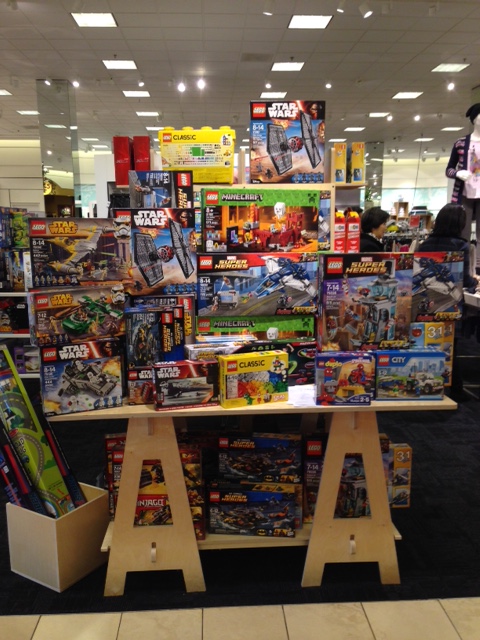
Nordstrom boys clothing department at Old Orchard mall, Skokie, IL
I wasn’t monitoring the licensing business in 1977, but this is the movie credited with initiating the modern licensing business. Given the institutionalization of licensing today, and the Disney machine behind Star Wars now, we’re no doubt looking at a licensing blockbuster of a whole different order of magnitude.
Today, for manufacturers and retailers waiting to release merchandise with the new movie’s art — remember, so far, with a few notable exceptions such as the BB-8 Droid, it’s been all classic images — it’s a matter of waiting for the force to awaken and do its part.
What will the net effect be on entertainment licensing for 2015-2017? Star Wars does not appear to be carrying the rest of the business up with it. Rather, it is displacing just about everything else. Still, in the aggregate it is more than compensating for others’ lost growth or stagnation, which is why entertainment licensing overall will show substantial growth for 2015 and probably 2016.
Licensing today is generally a matter of who are you going to knock off the shelf in order to get on. Star Wars is different, though: In addition to usurping others’ shelf space, Stars Wars found new distribution (such as at Nordstrom and Hudson) that hadn’t been given over to entertainment toys, apparel and collectibles to this degree before. That is enlarging the segment as a whole.
If the movie does indeed perform as expected, Star Wars will also be the worst news in licensing for everyone else in 2016 and, for Disney, an even worse story for 2017. Why?

Walgreens, downtown Chicago
Once Star Wars merchandising runs its course — and it will run its course — Disney will have to replace the Star Wars licensing juggernaut with something else. Even though there’s another movie scheduled for 2017, the second release in a series never generates the same in merchandise sales (and rarely at the box office) as the first. If superheroes are still in style — and that’s a big “if” — Disney will have Marvel to fall back on. Or perhaps they’ll have another Frozen. But it’s hard to bet on those scenarios.
The good news is that once Star Wars does run its course, that should re-open the shelves to other entertainment properties, and there’s no dearth of those in the wings.
Ira’s Fearless Forecast: Retail sales of licensed merchandise based on entertainment properties in the U.S. and Canada will be up 7%-9% for 2015.
Ira Mayer, former publisher and executive editor of The Licensing Letter, conducts competitive research and consults for companies in the licensing business; you can contact him by clicking on the “Contact” button at left.
Is Star Wars the (Old) New Frozen?
In the decade following the release of the original Star Wars movie in 1977 the licensing business overall grew more than 10 times, from $4.9 billion in retail sales that year to $54 billion in 1986, according to The Licensing Letter Databook.
Star Wars is credited as the catalyst for much of that growth — certainly in the entertainment sector, but across the rest of the licensing business as well. In recent years, worldwide retail sales of merchandise based on the Star Wars characters and imagery has hovered in the vicinity of $2 billion annually.
So as the rollout of new Star Wars merchandise begins this Friday, with a new movie coming in December, what are the prospects for Star Wars sales now?
A widely reported bullish analysis of Disney’s stock by Macquarie Securities analyst Tim Nollen puts the number at $5 billion in the first year following release of the movie (which is a funny time to start counting, since the merchandise is going on sale more than three months before the movie comes out). Good forecast or is Nollen building unrealistic expectations for investors?
“Star Wars is on a whole other level from anything we’ve ever done,” Dynomighty’s Sydney Pham told me at the NY NOW gift show in New York recently. Dynomighty makes Tyvek wallets, passport holders, and other accessories, and festooned its booth with Star Wars displays.
 “We started pre-selling the classic images a month before the [mid-August] show; we’ll have new images from the movie for the spring. But even the classic images are outselling all of the best-sellers we’ve had for eight years,” Pham said.
That’s pretty strong language. Joyce Washnik, editor of Giftbeat, a newsletter for the gift industry, sees Star Wars crossing all retail channels, including specialty gift stores which, traditionally, might not touch a pop culture phenomenon such as Star Wars because so much merchandise is available at Walmart, Target, and everywhere else.
Still, Washnik says, gift stores had a great run with Frozen and she sees Star Wars following in those footsteps. Frozen did just shy of $1 billion in retail sales of consumer products in its first year following release, based on my analysis of various Disney statements over the past few months. And that was for a property no one had ever heard of and for which Disney probably could have done more had the studio, retailers, and manufacturers anticipated the immediate success of the movie. (Not being able to anticipate that is why movies and merchandising are art not science, thank you.) In the case of Frozen, the licensing program had to be revved up quickly in response to the movie’s wildfire takeoff; needless to say, Disney knew what to do.
For perspective, Mickey Mouse and Hello Kitty do a little less than $4 billion each in retail sales of licensed merchandise annually, worldwide. Disney Princess and Winnie the Pooh are just below $3 billion each, and Cars and Star Wars have done about $2 billion each. Note that all but one of those — Hello Kitty — are owned by Disney.
If the new Star Wars movie bombs, which seems unlikely, Disney will still have built momentum and had three months to sell the goods. That’s analogous to most fast food promotions which end before the movie opens…just in case.
Nollen writes that Star Wars “could generate $5 billion in consumer merchandise sales in its first year of release…[and] this would easily net Disney about $500 million in licensing and retail revenue.”
Using the loosest of calculations, $5 billion — which is greater than the value of the entire licensing business pre-Star Wars! — would be $2.5 billion at wholesale. Since royalties are mostly calculated on wholesale, and the rule-of-thumb for rough estimates across all categories is a 10% royalty rate, that’s $250 million net to Disney. Even if the royalty is higher (likely), it’s still not going to come to $500 million. But $250 million? Even Mickey wouldn’t sneeze at that.
Good forecast or unrealistic expectation? As Robert Browning wrote, “Ah, but a man’s reach should exceed his grasp, Or what’s a heaven for?” Written for Star Wars, no?
Subscription Boxes & The Death of Columbia House
Funny how “subscription boxes” — the latest incarnation of what used to be called negative option subscription services, whereby you sign up to receive a monthly (typically) box of stuff (music, video, apparel, candy, what-have-you) unless you tell the sender otherwise in advance — are gaining popularity just as the owners of Columbia House, the granddaddy of negative option subscription operations which sent music or videos in the heyday of physical media, files for bankruptcy.
The Myth of One-to-One Marketing
“One-to-one marketing” is a great catchphrase, but in practice it has always been a myth unless you’re talking about a salesperson working directly with a customer.
When the concept was first popularized in 1993 by Don Peppers and Martha Rogers in their book, “The One to One Future,” the phrase was a marketing rallying cry: Traditional mass marketing was losing its impact; it was time to narrowcast, to speak to consumers one-to-one. Peppers and Rogers have built their company, 1to1 Media, on that foundation.
That was early Internet times. The technology wasn’t there, but the wake-up call was prescient: address your customers in a way that makes them feel as though they are being personally catered to.
I argued then (mostly in speeches) and still maintain that it is an illusory tactic. Making people feel as though your message was crafted just for them is a bit of legerdemain. Useful, but not really one-to-one.
Why not one-to-one? It isn’t cost effective. Despite the tools at our disposal now, one-to-one can rarely be implemented other than literally person to person. It’s too expensive to set up systems to truly be one-to-one responsive. Even when it seems obviously do-able.
Examples:
- I hadn’t been on Spotify since the first few weeks it was introduced. So I created a new account at the free level — knowing I’d be getting ads — and started listening to classical music. Mostly opera. The ads I got: Madonna. You would think that with all Spotify knows about my listening habits, they’d be the logical ones to craft one-to-one messages. Given the frequency of those Madonna ads, they clearly didn’t have many advertisers to choose from. You’d think they’d create house ads…but how many would they need?
- Our children are 26 and 29 years old. I haven’t bought children’s clothes at Lands’ End (or much of anyplace else) in many years. So why is Lands’ End — a company I shop regularly — sending me promos for school uniforms? And while we’re on the subject, why didn’t my customer history follow me when I changed my preferred email address? Now the better discounts go to an old mailbox, while the new address gets less favorable offers. (Which raises the further question of what better rates lurk that I don’t know about.)
Apart from the fact that it just doesn’t make economic sense to have every sales effort tailored to every individual based on their activity on a site or in-store purchase history, many of us have multiple family members logging in and browsing/purchasing, which understandably confuses the vendor’s system.
Netflix has sought to solve that problem by establishing separate accounts family members can use. While Netflix’s recommendations for my wife and me still often reflect other family members’ viewing preferences, it’s a start. Maybe Netflix is still drawing on older selections prior to setting up the separate accounts. Meanwhile, Amazon used to be dead-on with books recommended for me (especially in more arcane subject matter), but not so much anymore.
I’m hardly the only one mystified by the lack of coordination between viewing/purchase history and the recommendations I get. Joe Queenan wrote a piece in The Wall Street Journal recently, “Those Recommendations Don’t Compute.” I don’t expect one-to-one, but we should all at least receive loosely relevant when it’s online. The expectation online is different than, say, with a newspaper — a medium I still enjoy browsing precisely because I get to see things I wouldn’t search for or otherwise see — or even TV, where the expectation is still mass-targeted ads (destined to change eventually as well for all but the biggest event-viewing experiences such as the Super Bowl, where the ads are content in and of themselves).
On the plus side, my friend Andy tells me he got a promotion from Pandora pointing out that he’d listened to 800+ selections in a particular genre. The music network then suggested Pandora lists he should check out, and they were indeed relevant. That said, he summed up the concern many of us have about moving our listening from physical to online media: “maintaining the continuity of ownership.” That, however, is subject for another day.
What I Learned At Licensing Expo 2015, Part III: More Open to the New
There were quite a few new character properties exhibited at Licensing Expo in Las Vegas early in June. And while the drumbeat in recent years has been how difficult it is for anything new to penetrate the market — in particular to get on the shelf at retail — a number of attendees commented to me this year that there was a sense that “the market is more secure, and therefore more open to considering something new.”
Most attention, of course, focuses on “new” from Disney/Marvel/Star Wars, Nickelodeon, Warner, Turner, spinoffs, reboots, and so on. But here are some notes on two of the odder newbies, a new digital hit (Bethany Mota; more on digital properties in an upcoming post), collaborations, distribution strategies, and more.
Will the newbies be back next year? Stay tuned.
Opportunistic Anime. John Prine and the late singer/songwriter extraordinaire Steve Goodman set out to write the perfect country and western song by including every country song cliché they could, including mama, trains, trucks, prison, and being drunk. The result was “You Never Even Call Me By My Name,” which was a country hit for David Allen Coe in 1975. I don’t know if the folks at Genco, part of the Daisuki Anime Consortium Japan, have heard the song or would get the joke (most of the clichés are bunched up in one final verse), but they were at Licensing Expo concept-testing Sushi Ninja, who “fight with evil Monsters for justice every day.” While they fight largely over silly things, there are only three episodes so far. Not sure it’s really for kids, or whether the humor can hold up over a full season, but so far it’s pretty funny in a SpongeBob-by sort of way.
Flush Here. Jim and Dan Chianese are brother podiatrists in Blacksburg, VA, and Charleston, WV, respectively. They are also the inventors, if you will, of Toilet Babies, a line of five (so far) “characters” that reside in Kalimapoo. You probably get the idea already. If not, go to their website. Each character has his own backstory — and yes, they are all male.

Toilet Babies characters include Lincoln’s Log and Spooky Dooky, among others, at $12.99 each. Bowl not included.
The brothers sourced 2000 of each character in China, have interest from a distributor for Japan, thought the line would appeal to 3-8 year-olds but have found the range is more 18-40 (in part, no doubt, because the only way to purchase them is online via credit card or PayPal), and exhibited at Toy Fair West and Licensing Expo in search of unloading the concept (sorry) on licensees. “We’re doctors, and we figured we’d follow the motto we follow in our practices: ‘What you don’t know, ship out.’ That’s where licensing comes in.” Contact: dnjcollectibles@gmail.com.
Learning to Fly on the Fly. When Aeropostale decided to launch an exclusive line around digital celebrity Bethany Mota, it was “two months from agreement to stores,” early in December 2013, in order to make the holidays, says the retailer’s Scott Birnbaum. Aeropostale is making 8-12 deliveries a year on the line, and when Mota makes live appearances (25 “meetups” so far, attracting 2500-3000 each, on average), she has to change outfits several times because the stores sell out instantly of whatever she wears.
Making Lemonade Out of… Animaccord VP of Licensing Vladimir Gorbulya, representing the popular Russian property Masha and the Bear, which launches dubbed in English in the U.S. on Netflix this August, says they “don’t want to crowd the market with episodes.” They have 51 short-form episodes of the core series (it would take three to fill a half-hour U.S. slot on broadcast or cable). There are two spinoffs: Masha’s Tales and Masha’s Scary Tales. The program already has a strong YouTube following in the U.S. European toy chain Hamleys features Masha in a store-in-store concept in Russia; next up will be Italy. (The property does not show up on Hamleys’ English-language website.) Animaccord issues 2-3 stylebooks annually to keep the property fresh.
Sound the Trumpets. Signage at the Fox booth at Licensing Expo heralds Ice Age having amassed $1.4 billion in merchandise sales (cumulatively, worldwide), with 2.5 million books in print. . . .Fox figuratively threw its trademark searchlight on exclusive retail and design collaborations including Simpsons x Joyrich, Simpsons x MAC, Home Alone x Rook, and others in signage adorning the outer walls of its booth. . . .Authentic Brands Group (ABG) hardly needed more than the giant TV over the entrance to its booth, what with a running loop of images featuring properties it owns and represents, including Muhammad Ali, Marilyn Monroe, Michael Jackson, and Elvis Presley.
Nice Touch. Kudos to Advanstar for adding a “character parade” the opening day of the show. Several dozen characters wound their way slowly through the aisles, making for plenty of smiles and some neat once-in-a-lifetime photo ops. On their own, The Minions were especially popular at Universal’s booth, while the Teletubbies made an appearance at the LIMA Awards festivities.

The character parade made for some strange bedfellows.

LIMA General Counsel Greg Battersby and mystery guests at the LIMA Awards ceremony.
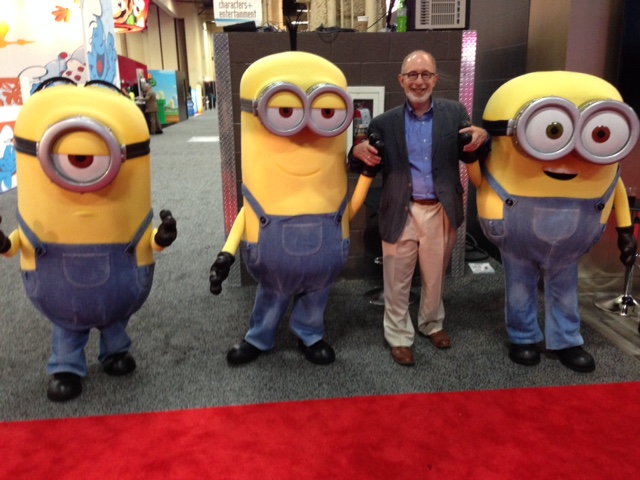
Your humble reporter befriends the Minions.
What I Learned At Licensing Expo 2015, Part II: Beyond ‘Device-Agnostic’
The younger the consumer the less he or she cares which device they watch or listen to. It’s been apparent for several years now that they don’t think in terms of computer, stereo, smartphone, TV, radio, etc. They want their content on whatever device is convenient at the moment.
But they also don’t think in terms of film or a game or a traditional TV show or a Netflix or YouTube or other video. It’s all entertainment to them, a fact that is underscored by the way PBS Kids emphasizes digital games for its preschool shows; movies deliver trailers a year out and prolong the life of a release through, again, games and other online extensions; or TV shows extend their season with mini-episodes online.
All of this is cause for a wholesale re-thinking of how all forms of entertainment are marketed — let alone how entertainment consumption is measured.
A complaint that came up repeatedly at Licensing Expo this year from toy companies, movie studios, TV and video networks, and other IP owners, and which I’ve heard from people in music and other entertainment sectors as well, is how difficult it is to measure the popularity of a given movie, TV show, music recording, game or other piece of “content” across even the major platforms.
Whether YouTube or Netflix or Amazon or Facebook or Twitter or Spotify or… the owner of a piece of intellectual property has to go into each platform’s analytics independently, with no shared interface to simplify the process.
For marketers that means learning a host of analytics systems when all they really want is “the numbers” and probably aren’t statisticians. For large companies with dedicated departments that’s not a big issue. For anyone else (and that includes most companies), it is a very big issue indeed.
Is there anything out there that aggregates this wide range of user data across platforms?
 Mayer On Marketing, Licensing, and Merchandising